मराठी

In the given figure, (\mathrm{OD}=2 \times \mathrm{OB}), (\mathrm{OC}=2 \times \mathrm{OA}) and (\mathrm{CD}=2 \times \mathrm{AB}) then (\triangle \mathrm{AOB} \sim \triangle \mathrm{COD}) by ______.

Advertisements
Advertisements

प्रश्न

In the given figure, OD = 2 × OB, OC = 2 × OA and CD = 2 × AB then △ AOB ~ △ COD by ______.
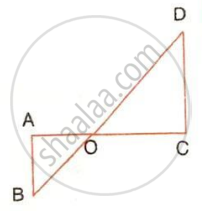
पर्याय

  • AA

  • SS

  • SAS and SSS

  • SSS

MCQ
रिकाम्या जागा भरा
Advertisements

उत्तर

SSS

Explanation:

Given,

⇒ OD = 2 × OB

⇒ `(OD)/(OB)`​ = 2 .......(1)

⇒ OC = 2 × OA

⇒ `(OC)/(OA​)` = 2 .......(2)

⇒ CD = 2 × AB

⇒ `(CD)/(AB)​` = 2 .......(3)

From equation (1), (2) and (3), we get:

⇒ `(OD)/(OB) = (OC)/(OA​) = (CD)/(AB)`

∴ △ AOB ~ △ COD (By S.S.S. postulate)

shaalaa.com
  या प्रश्नात किंवा उत्तरात काही त्रुटी आहे का?
पाठ 15: Similarity (With Applications to Maps and Models) - EXERCISE 15 (A) [पृष्ठ २१५]

APPEARS IN

सेलिना Concise Mathematics [English] Class 10 ICSE
पाठ 15 Similarity (With Applications to Maps and Models)
EXERCISE 15 (A) | Q 1. (i) | पृष्ठ २१५
Share
Notifications

Englishहिंदीमराठी


      Forgot password?
Use app×