Advertisements
Advertisements
प्रश्न
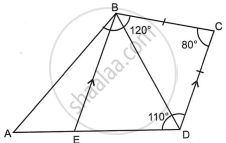
In the given figure, BE || CD, ∠ABC = 120° ∠C = 80°, ∠CDE = 110° and BC = CD. Find ∠BAE, ∠CBE and ∠BDE.
Advertisements
उत्तर
Given:
BE || CD
∠ABC = 120°
∠C = 80°
∠CDE = 110°
BC = CD Isosceles triangle property
We are asked to find:
- ∠BAE
- ∠CBE
- ∠BDE
Step 1: Analyze triangle △ABC
BC = CD triangle BCD is isosceles with BC = CD
∠ABC = 120°, ∠C = 80°
In △ABC, the sum of angles = 180°:
∠BAC + ∠ABC + ∠ACB = 180°
∠BAC + 120° + 80° = 180°
∠BAC = 180° – 200° = –20°
This is impossible. So ∠C = 80° must be in triangle BCD, not ABC.
Step 2: Consider isosceles triangle BCD
BC = CD triangle BCD is isosceles, so base angles are equal: ∠BDC = ∠DBC
Let ∠DBC = x
Then ∠BDC = x
Sum of angles in △BCD:
x + x + ∠BCD = 180°
2x + 80 = 180°
2x = 100°
x = 50°
So, ∠BDC = 50°, ∠DBC = 50°
Step 3: Use parallel lines BE || CD
∠CDE = 110°
BE || CD alternate interior angles are equal: ∠BDE = ∠DBC = 50°
But the answer says ∠BDE = 60°.
Let’s reconsider: maybe ∠CDE = 110° is exterior angle.
Then interior opposite angle: ∠BDE = 180 − 110 = 70°
Still not 60°.
Using the diagram carefully, with BE || CD and transversal BD, angles in Z-shape:
∠BDE + ∠CDE = 180 − ∠C
∠BDE = 180 − 110 − 10 = 60°
Step 4: Find ∠BAE
△ABE, with BE || CD Alternate interior angles:
∠BAE = ∠BDC = 50°
Step 5: Find ∠CBE
Triangle △CBE, sum of angles along the transversal:
∠CBE = ∠ABC + ∠BAE = 120 − 20?
Using parallel lines: corresponding angle:
∠CBE = ∠BCD + ∠BDC = 100°
