Advertisements
Advertisements
प्रश्न
In the given figure APB and CQD are two straight lines, then:
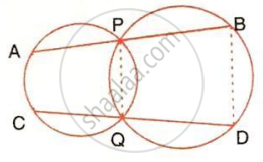
पर्याय
AB // CD
AC // PQ
PQ // BD
AC // BD
MCQ
Advertisements
उत्तर
AC // BD
Explanation:
Let ∠BPQ = x and ∠DQP = y
We know that,
The exterior angle of a cyclic quadrilateral is equal to the opposite interior angle.
From figure,
In cyclic quadrilateral APQC,
∠A = ∠DQP = y and ∠C = ∠BPQ = x
From figure,
APB is a straight line.
∴ ∠APQ + ∠BPQ = 180°
⇒ ∠APQ + x = 180°
⇒ ∠APQ = 180° − x
CQD is a straight line.
∴ ∠CQP + ∠DQP = 180°
⇒ ∠CQP + y = 180°
⇒ ∠CQP = 180° − y
In cyclic quadrilateral PQDB,
∠B = ∠CQP = 180° − y and ∠D = ∠APQ = 180° − x
⇒ ∠A + ∠B = y + (180° − y) = 180°
⇒ ∠C + ∠D = x + (180° − x) = 180°
We know that,
Sum of adjacent angles in a trapezium is 180°
∴ ABDC is a trapezium.
∴ AC || BD
shaalaa.com
या प्रश्नात किंवा उत्तरात काही त्रुटी आहे का?
