In the given figure, (\angle \mathrm{ACB} = 52^{\circ}) and (\angle \mathrm{BDC} = 43^{\circ}). Calculate: i. (\angle \mathrm{ADB}) ii. (\angle \mathrm{BAC}) iii. (\angle \mathrm{ABC})
Advertisements
प्रश्न
In the given figure, \(\angle \mathrm{ACB} = 52^{\circ}\) and \(\angle \mathrm{BDC} = 43^{\circ}\).
Calculate:
- \(\angle \mathrm{ADB}\)
- \(\angle \mathrm{BAC}\)
- \(\angle \mathrm{ABC}\)
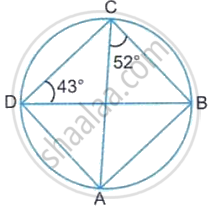
[Hint. Look at the angles in the same segment.]
बेरीज
Advertisements
उत्तर
i. $$\angle ADB = \angle ACB = 52^\circ$$ (Angles in the same segment AB).
ii. $$\angle BAC = \angle BDC = 43^\circ$$ (Angles in the same segment BC).
iii. In $$\triangle ABC$$, $$\angle ABC = 180^\circ - 52^\circ - 43^\circ = 85^\circ$$.
shaalaa.com
या प्रश्नात किंवा उत्तरात काही त्रुटी आहे का?
