Advertisements
Advertisements
प्रश्न
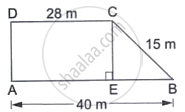
In the given figure ABCD is a trapezium in which AB = 40 m, BC = 15 m, CD = 28 m, AD = 9 m and CE ⊥ AB. The area of trap. ABCD is ______.
पर्याय
306 m2
316 m2
296 m2
284 m2
MCQ
रिकाम्या जागा भरा
Advertisements
उत्तर
In the given figure ABCD is a trapezium in which AB=40 m, BC =15 m, CD = 28 m, AD = 9 m and CE ⊥ AB. The area of trap. ABCD is 306 m2.
Explanation:
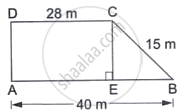
Put A = (0, 0), B = (40, 0).
Let CE ⟂ AB meet AB at E.
So C = (x, h) and D = (x – 28, h).
From AD = 9: (x – 28)2 + h2
= 92
= 81
From BC = 15: (40 – x)2 + h2
= 152
= 225
Subtracting the two equations gives x = 28.
So h2 = 225 – (40 – 28)2
= 225 – 144
= 81
⇒ h = 9
Area of trapezium = `1/2 xx ("sum of parallel sides") xx "height"`
= `1/2 xx (40 + 28) xx 9`
= 306 m2
shaalaa.com
या प्रश्नात किंवा उत्तरात काही त्रुटी आहे का?
