Advertisements
Advertisements
प्रश्न
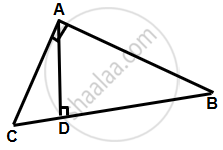
In the given figure, ΔABC is right angled triangle with ∠A = 90°. AD is perpendicular to BC.
Prove that:
- ΔDBA ∼ ΔDAC
- DA2 = DB × DC
- Find the area of ΔABC when DB = 9 cm and DC = 16 cm.
Advertisements
उत्तर
Given:
ΔABC is right angled at A (i.e., ∠A = 90°)
AD is perpendicular to BC
To prove:
- ΔDBA ∼ ΔDAC
- DA2 = DB × DC
- Find the area of ΔABC when DB = 9 cm and DC = 16 cm.
i. Prove ΔDBA ∼ ΔDAC
In ΔDBA and ΔDAC:
∠ADB = ∠ADC = 90° ...(Since AD ⊥ BC)
∠DBA = ∠DAC ...(Common angles in the triangles)
By AA (Angle-Angle) similarity criterion,
ΔDBA ∼ ΔDAC
ii. Prove DA2 = DB × DC
Since ΔDBA ∼ ΔDAC, corresponding sides are proportional:
`(DA)/(DB) = (DC)/(DA)`
⇒ DA2 = DB × DC
iii. Find the area of ΔABC when DB = 9 cm and DC = 16 cm
From part (ii),
DA2 = DB × DC
= 9 × 16
= 144
⇒ DA = 12 cm
Since ΔABC is right angled at A, AD is the height from A to hypotenuse BC.
Length of BC = DB + DC
= 9 + 16
= 25 cm
Area of ΔABC is given by:
Area = `1/2 xx BC xx AD`
= `1/2 xx 25 xx 12`
= 150 cm2
