Advertisements
Advertisements
प्रश्न
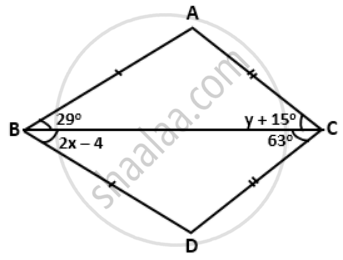
In the given figure, AB = DB and AC = DC. Find the values of x and y.
Advertisements
उत्तर

In ΔABC and ΔDBC
AB = DB ....[given]
AC = DC ....[given]
BC = BC ....[common]
∴ By Side-Side-Side criterion of congruence,
ΔABC ≅ ΔDBC
∴ ∠ACB =∠DBC ....[c.p.c.t]
⇒ y + 15° = 63°
⇒ y = 63° - 15°
⇒ y = 48°
Now, ∠ABC = ∠DBC ....[c.p.c.t]
⇒ 29° = 2x - 4°
⇒ 2x = 29° + 4°
⇒ 2x = 33°
⇒ x = `(33°)/(2)`
⇒ x = 16.5°
Hence, x = 16.5° and y = 48°.
APPEARS IN
संबंधित प्रश्न
If ΔDEF ≅ ΔBCA, write the part(s) of ΔBCA that correspond to `bar(EF)`
In triangles ABC and PQR, if ∠A = ∠R, ∠B = ∠P and AB = RP, then which one of the following congruence conditions applies:
In an isosceles triangle, if the vertex angle is twice the sum of the base angles, then the measure of vertex angle of the triangle is
If ABC and DEF are two triangles such that ΔABC \[\cong\] ΔFDE and AB = 5cm, ∠B = 40°
Observe the information shown in pair of triangle given below. State the test by which the two triangles are congruent. Write the remaining congruent parts of the triangles.

From the information shown in the figure,
In ΔABC and ΔPQR
∠ABC ≅ ∠PQR
seg BC ≅ seg QR
∠ACB ≅ ∠PRQ
∴ ΔABC ≅ ΔPQR ...`square` test
∴ ∠BAC ≅ `square` ...corresponding angles of congruent triangles.
`{:("seg AB" ≅ square),("and" square ≅ "seg PR"):}}` ...corresponding sides of congruent triangles
The following figure has shown a triangle ABC in which AB = AC. M is a point on AB and N is a point on AC such that BM = CN.
Prove that: (i) AM = AN (ii) ΔAMC ≅ ΔANB

State, whether the pairs of triangles given in the following figures are congruent or not:
Δ ABC in which AB = 2 cm, BC = 3.5 cm and ∠C = 80° and Δ DEF in which DE = 2 cm, DF = 3.5 cm and ∠D = 80°.
In the given figure, prove that: ∆ ABD ≅ ∆ ACD

In a triangle ABC, if D is midpoint of BC; AD is produced upto E such as DE = AD, then prove that:
a. DABD andDECD are congruent.
b. AB = EC
c. AB is parallel to EC
Sides, AB, BC and the median AD of ΔABC are equal to the two sides PQ, QR and the median PM of ΔPQR. Prove that ΔABC ≅ ΔPQR.

