Advertisements
Advertisements
प्रश्न
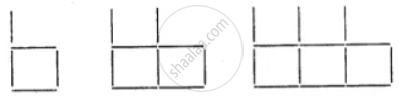
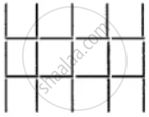
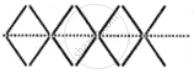
- In each of the following patterns, construct next figure.
- In each case, if n denotes the number of figure and F denotes the number of matchsticks used, find F in terms of n.
- Also find, in each case, how many matches are required to make the: 16th figure and 30th figure.



Advertisements
उत्तर
a
.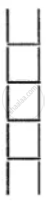
b
.
c
.
d

e

f
.
i.
(a) F = 3n + 2
(b) F = 4n + 1
(c) F = 5n + 3
(d) F = 5n + 1
(e) F = 4n + 1
(f) F = 4n - 2
ii. 16th figure
(a) F = 3 x 16 + 2 = 50
(b) F = 4 x 16 + 1 = 65
(c) F = 5 x 16 + 3 = 83
(d) F = 5 x 16 + 1 = 81
(e) F = 4 x 16 + 1 = 65
(f) F = 4 x 16 - 2 = 62
iii. 30th figure
(a) F = 3 x 30 + 2 = 92
(b) F = 4 x 30 + 1 = 121
(c) F = 5 x 30 + 3 = 153
(d) F = 5 x 30 + 1 = 151
(e) F = 4 x 30 + 1 = 121
(f) F = 4 x 30 - 2 = 118
APPEARS IN
संबंधित प्रश्न
Fill in the blank:
286 + 0 = ______
By re-arranging the given numbers evaluate :
162 + 253 +338 + 47
State True or False:
The sum of two even numbers is an even number.
State True or False:
Every natural number is a whole number.
Fill in the blanks :
98 x 273 – 75 x 273 = ( _____ ) x 273 =_____ x 273
Solve:
111 ÷ 3 = 37
222 ÷ 6 = 37
333 ÷ 9 = 37
Complete the following magic squares:
| 4 | _______ | 8 |
| _______ | 7 | ________ |
| _______ | _______ | 10 |
The HCF of two or more given numbers is the highest of their common _____.
The smallest natural number is zero.
To ensure the result is an odd natural number, n (a natural number) must be used in which form?
