Advertisements
Advertisements
प्रश्न
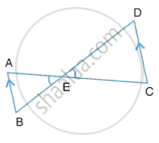
In the following figure, `(EA)/(EC) = (EB)/(ED)`, prove that ΔEAB ~ ΔECD.
Advertisements
उत्तर
Given: `(EA)/(EC) = (EB)/(ED)`.
To Prove: ΔEAB ~ ΔECD.
Proof [Step-wise]:
1. From the given ratio `(EA)/(EC) = (EB)/(ED)`, take k = `(EC)/(EA) = (ED)/(EB)` (so k > 0).
2. Consider a dilation (homothety) with centre E and scale factor k. A dilation about E multiplies every distance from E by k and preserves angles (hence it sends lines through E to themselves and preserves the angle between any two rays from E).
3. Apply this dilation to A: its image A’ satisfies EA’ = k·EA = EC, so A’ coincides with C. Similarly, apply the dilation to B: its image B' satisfies EB’ = k·EB = ED, so B' coincides with D. Thus the dilation maps A → C and B → D, so it carries segment AB to segment CD and triangle EAB to triangle ECD.
4. Because a dilation (centered at E) is a similarity transformation, it preserves all angles and produces proportional corresponding sides. Therefore the image triangle EAB is similar to ECD (corresponding vertices E→E, A→C, B→D). Alternatively, from the mapping we get the equalities of corresponding angles: ∠AEB = ∠CED, ∠EAB = ∠ECD and ∠EBA = ∠EDC, and the corresponding sides are in proportion, confirming similarity by the SAS (or AA) criterion.
Hence ΔEAB ~ ΔECD.
