Advertisements
Advertisements
प्रश्न
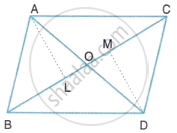
In the following figure, ΔАВC and ΔDBC are on the same base BC. If AD and BC intersect at O, prove that `(Area (ΔABC))/(Area (ΔDBC)) = (AO)/(DO)`.
Advertisements
उत्तर
Given:
ΔABC and ΔDBC are on the same base BC.
AD meets BC at O.
To Prove: `(Area(ΔABC))/(Area(ΔDBC)) = (AO)/(DO)`.
Proof [Step-wise]:
1. Area formula: For any triangle, area = `1/2` × base × corresponding height.
2. Since ΔABC and ΔDBC have the same base BC, their areas are ar(ΔABC) = `1/2` × BC × hA and ar(ΔDBC) = `1/2` × BC × hD, where hA and hD are the perpendicular distances (heights) from A and D to line BC respectively.
3. Let θ be the angle between line AD and line BC. Because A and D lie on the same straight line AD through O, the perpendicular distance from A to BC equals AO × sin θ and the perpendicular distance from D to BC equals DO × sin θ. Heights measured to the same line differ by the same sine factor because they are projections of AO and DO onto the perpendicular direction.
4. Substitute these heights into the area expressions:
`ar(ΔABC) = 1/2 xx BC xx (AO xx sin θ)`
`ar(ΔDBC) = 1/2 xx BC xx (DO xx sin θ)`
5. Take the ratio:
`(ar(ΔABC))/(ar(ΔDBC)) = (1/2 xx BC xx AO xx sin θ)/(1/2 xx BC xx DO xx sin θ)`
= `(AO)/(DO)` ...(All common factors `1/2`, BC and sin θ cancel.)
Therefore `(Area (ΔABC))/(Area(ΔDBC)) = (AO)/(DO)`, as required.
