Advertisements
Advertisements
प्रश्न
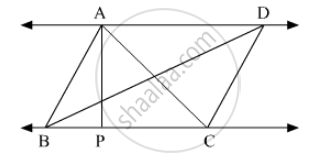
In the following figure, AP ⊥ BC, AD || BC, then find A(∆ABC): A(∆BCD).
बेरीज
Advertisements
उत्तर
Formula for a triangle:
`A = 1/2 xx ` base × height
Use geometric observations
BC is common base for both triangles
For △ABC, height is AP
For △BCD, since AD∥BC, the height from D to BC is equal to height from A to BC (i.e., same as AP)
BUT the triangle ABC only spans from A to C, while △BCD spans from D to C, depending on the full coordinates or positions, we need to visually estimate the areas.
From the figure:
-
Point A is vertically above point PPP, with P ∈ BC
-
Triangle ABC is left of diagonal AD
-
Triangle BCD is right of diagonal AD
From symmetry, it appears:
A(∆ABC) = A(∆BCD)
`(A(ΔABC))/(A(ΔBCD)) = 1:1`
shaalaa.com
या प्रश्नात किंवा उत्तरात काही त्रुटी आहे का?
