Advertisements
Advertisements
प्रश्न
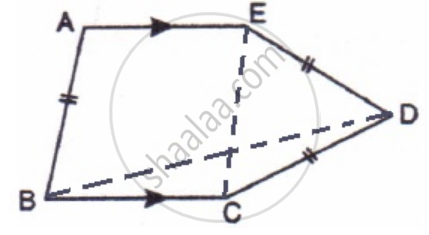
In the following figure, AE and BC are equal and parallel and the three sides AB, CD, and DE are equal to one another. If angle A is 102°.
Find angles AEC and BCD.
बेरीज
Advertisements
उत्तर
In the given figure
Given that AE = BC
We have to find ∠AEC and ∠BCD
In the quadrilateral AECB
(AE = BC and AE || BC)
So quadrilateral is a parallelogram
⇒ ∠BAE + ∠AEC = 180°
⇒ 102° + ∠AEC = 180°
⇒ ∠AEC = 78°
Also, ∠BAE = ∠BCE = 102°
AB = EC ...(Because AECB is a parallelogram)
Now consider ΔECD
EC = ED = CD ...[Since AB = EC]
Therefore, ΔEDC is an equilateral triangle.
⇒ ∠ECD = 60°
∠BCD = ∠BCE + ∠ECD
⇒ ∠BCD = 102° + 60°
⇒ ∠BCD = 162°
Therefore, ∠AEC = 78° and ∠BCD = 162°
shaalaa.com
या प्रश्नात किंवा उत्तरात काही त्रुटी आहे का?
