Advertisements
Advertisements
प्रश्न
In the following figure, ΔACB ~ ΔAPQ. If BC = 10 cm, PQ = 5 cm, BA = 6.5 cm and AP = 2.8 cm, find CA and AQ. Also, find the area (ΔACB): area (ΔAPQ).
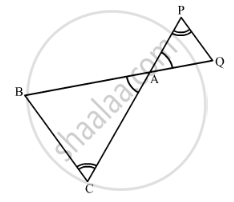
In the following figure, ΔACB ~ ΔAPQ. If BC = 10 cm, PQ = 5 cm, BA = 6.5 cm and AP = 2.8 cm, find CA and AQ. Also, find the area (ΔACB): area (ΔAPQ).
बेरीज
Advertisements
उत्तर
We have,
ΔACB ~ ΔAPQ
Then,
`"AC"/"AP"="CB"/"PQ"="AB"/"AQ"` [Corresponding parts of similar Δ are proportional]
`rArr"AC"/2.8=10/5=6.5/"AQ"`
`rArr"AC"/2.8=10/5` and `10/5=6.5/"AQ"`
`rArr"AC"=10/5xx2.8` and `"AQ"=6.5xx5/10`
⇒ AC = 5.6 cm and AQ = 3.25 cm
By area of similar triangle theorem
`("Area"(triangleACB))/("Area"(triangleAPQ))/"BC"^2/"PQ"^2`
`=10^2/5^2`
`=100/25`
= 4
shaalaa.com
या प्रश्नात किंवा उत्तरात काही त्रुटी आहे का?
