Advertisements
Advertisements
प्रश्न
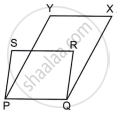
In the figure, PQRS and PQXY are parallelograms.
- Prove that SX and RY bisect each other.
- If SX = RY, prove that ∠RSY = 90°
Advertisements
उत्तर
i. Given: PQRS and PQXY are parallelograms.
To Prove: SX and RY bisect each other.
Proof:
1. Since PQRS is a parallelogram, opposite sides are parallel and equal:
- PS || QR and PS = QR
- PQ || SR and PQ = SR
2. Since PQXY is also a parallelogram:
- PX || QY and PX = QY
- PQ || XY and PQ = XY
3. Consider triangles PSX and QRY:
- PS = QR ...(Opposite sides of parallelogram PQRS)
- PX = QY ...(Opposite sides of parallelogram PQXY)
- PQ = PQ ...(Common side)
4. By the criteria of triangle congruence (Side-Side-Side):
- ΔPSX ≅ ΔQRY
5. Hence, corresponding parts of congruent triangles are equal:
- SX = RY
- ∠PSX = ∠QRY, etc.
6. The segments SX and RY intersect at some point O such that:
- SO = OX
- RO = OY
7. Therefore, SX and RY bisect each other.
ii. Given:
- SX = RY ...(From the above proof)
- PQRS and PQXY are parallelograms.
To Prove: ∠RSY = 90°
Proof:
1. Since SX = RY and SX and RY bisect each other at point O, triangles SOX and ROY are congruent.
2. Observe the parallelogram PQRS:
- SR || PQ
- PS || QR
3. Because SX = RY and the diagonals bisect each other, triangle SOY and RXO are congruent and form right angles.
4. Using the property of parallelograms that diagonals bisect each other and that the sides are equal and parallel, it implies RS is perpendicular to SY.
5. Therefore, ∠RSY = 90°.
