Advertisements
Advertisements
प्रश्न
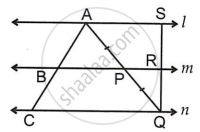
In the figure, lines l, m and n are parallel. AP = PQ. Find
- BC if AB = 3.5 cm
- SQ if RQ = 2.8 cm
- CQ if BP = 3.2 cm
- PR if AS = 7.4 cm
- BR if AS = 6.5 cm and CQ = 9.5 cm
Advertisements
उत्तर
i. Find BC if AB = 3.5 cm
On left transversal `AC: (AB)/(BC)`
= `(AP)/(PQ)`
= 1
⇒ AB = BC
\[\boxed{\text{BC = 3.5 cm}}\]
ii. Find SQ if RQ = 2.8 cm
Right vertical S – R – Q is a transversal. With equal spacing, SR = RQ = 2.8.
So SQ = SR + RQ
= 2.8 + 2.8
= \[\boxed{\text{5.6 cm}}\]
iii. Find CQ if BP = 3.2 cm
Between the two slant transversals (left and right sides), the widths on m and n are in the ratio of their levels:
BP : CQ = (height `l → m`) : (height `l → n`) = 1 : 2.
So CQ = 2 × BP
= 2 × 3.2
= \[\boxed{\text{6.4 cm}}\]
iv. Find PR if AS = 7.4 cm
Consider the two transversals: right slant AQ and right vertical SQ. They meet at Q. Bases on parallels are AS (on l), PR (on m), QR (= 0 on n at the vertex). With equal spacing,
`(PR)/(AS) = ("height" Q → m)/("height" Q → l) = 1/2`
⇒ `PR = (AS)/2`
= `(7.4)/2`
= \[\boxed{\text{3.7 cm}}\]
v. Find BR if AS = 6.5 cm and CQ = 9.5 cm
Between transversals “left slant” and “right vertical”, the widths on l, m, n are in arithmetic progression (linear with level).
Hence the middle width equals the average:
`BR = (AS + CQ)/2`
`(6.5 + 9.5)/2`
= \[\boxed{\text{8 cm}}\]
