Advertisements
Advertisements
प्रश्न
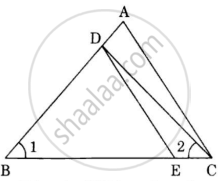
In the figure given below, ∠1 = ∠2 and `(BE)/(BC) = (CD)/(AB)`. Prove that ΔBDE ∼ ΔBAC.
Advertisements
उत्तर
Given:
1. ∠1 = ∠2
2. `(BE)/(BC) = (CD)/(AB)`
To Prove: ΔBDE ∼ ΔBAC
Proof:
Step 1: Use the angle equality
In ΔBCD, we are given that ∠1 = ∠2 which are ∠DBC and ∠BCD.
BD = CD ...(Sides opposite to equal angles in a triangle are equal)
Step 2: Substitute into the given ratio
We are given the ratio:
`(BE)/(BC) = (CD)/(AB)`
Substituting CD with BD (from Step 1), we get:
`(BE)/(BC) = (BD)/(AB)`
By rearranging the terms, we can write:
`(BD)/(AB) = (BE)/(BC)`
Step 3: Establish Similarity
Now, let’s look at ΔBDE and ΔBAC:
1. `(BD)/(BA) = (BE)/(BC)` ...(From our substitution in Step 2)
2. ∠B = ∠B ...(This is a common angle for both triangles)
ΔBDE ∼ ΔBAC by the SAS (Side-Angle-Side) similarity criterion.
