Advertisements
Advertisements
प्रश्न
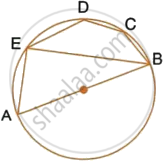
In the figure given alongside, AD is the diameter of the circle. If ∠ BCD = 130°, Calculate: (i) ∠ DAB (ii) ∠ ADB.

Advertisements
उत्तर
(i) Since ABCD is a cyclic quadrilateral.
∴ Its Opposite angles are supplementary.
∴ ∠ DAB + ∠ BCD = 180°
⇒ ∠ DAB = 180° - ∠ BCD
⇒ ∠ DAB = 180° - 130°
⇒ ∠ DAB = 50°
(ii) Since, angle in the semicircle is a right angle.
∴ In Δ ABD, ∠ABD = 90°
Since, the sum of the angle of a triangle is 180°
∴ ∠ABD + ∠ADB + ∠ DAB = 180°
∴ 90° + ∠ADB + 50° = 180°
∠ADB = 180° - (90° + 50°)
∠ADB = 180° - 140°
∠ADB = 40°
संबंधित प्रश्न
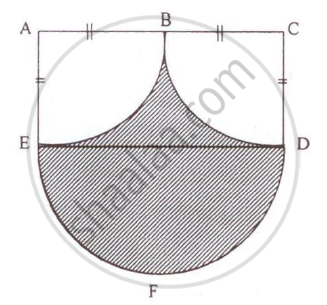
Calculate the area of the shaded region, if the diameter of the semicircle is equal to 14 cm. Take `pi = 22/7`
ABC is a right angles triangle with AB = 12 cm and AC = 13 cm. A circle, with centre O, has been inscribed inside the triangle.
Calculate the value of x, the radius of the inscribed circle.

Two circles intersect at P and Q. Through P diameters PA and PB of the two circles are drawn. Show that the points A, Q and B are collinear.
In the given figure, RS is a diameter of the circle. NM is parallel to RS and ∠MRS = 29°. Calculate : ∠RNM

ABCD is a cyclic quadrilateral in which AB is parallel to DC and AB is a diameter of the circle. Given ∠BED = 65°, calculate:
- ∠DAB,
- ∠BDC.
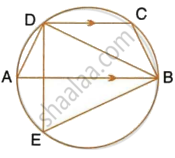
In the given figure, AB is a diameter of the circle. Chord ED is parallel to AB and ∠EAB = 63°.
Calculate:
- ∠EBA,
- ∠BCD.

In the following figure, AD is the diameter of the circle with centre O. Chords AB, BC and CD are equal. If ∠DEF = 110°, calculate: ∠AEF

The following figure shows a circle with PR as its diameter. If PQ = 7 cm and QR = 3RS = 6 cm, find the perimeter of the cyclic quadrilateral PQRS.

In the given figure, AB is a diameter of the circle. Chord ED is parallel to AB and ∠EAB = 63°. Calculate : ∠BCD.
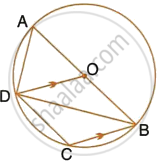
In the given figure, AB is a diameter of the circle with centre O. DO is parallel to CB and ∠DCB = 120°.
Calculate : ∠DBA
Also, show that the ΔAOD is an equilateral triangle.