Advertisements
Advertisements
प्रश्न
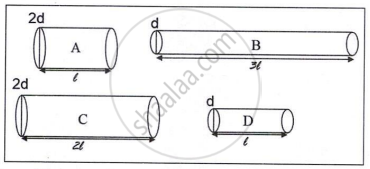
In the diagram, calculate the ratio of the resistances A, B, C and D.
Advertisements
उत्तर
The resistance (R) of a cylindrical conductor is given by:
R = `ρL/A`
Since all conductors are made of copper (same resistivity \(\rho \)) and the cross-sectional area \(A \propto D^2\) (where \(D\) is the diameter), the relation simplifies to:
`R ∝ L/D^2`
Let's determine the relative resistance value for each conductor:
Resistance of A (\(R_{A}\)):
\[ R_{A} \propto \frac{l}{(2d)^{2}} = \frac{l}{4d^{2}} = \frac{1}{4}\left(\frac{l}{d^{2}}\right) \]
Resistance of B (\(R_{B}\)):
\[ R_{B} \propto \frac{3l}{d^{2}} = 3\left(\frac{l}{d^{2}}\right) \]
Resistance of C (\(R_{C}\)):
\[ R_{C} \propto \frac{2l}{(2d)^{2}} = \frac{2l}{4d^{2}} = \frac{1}{2}\left(\frac{l}{d^{2}}\right) \]
Resistance of D (\(R_{D}\))
\[ R_{D} \propto \frac{l}{d^{2}} = 1\left(\frac{l}{d^{2}}\right) \]
Taking the ratio \(R_A : R_B : R_C : R_D\):
\[ R_{A} : R_{B} : R_{C} : R_{D} = \frac{1}{4} : 3 : \frac{1}{2} : 1 \]
To simplify this into whole numbers, multiply the entire ratio by 4 (the lowest common denominator):
\[ = \left(\frac{1}{4} \times 4\right) : (3 \times 4) : \left(\frac{1}{2} \times 4\right) : (1 \times 4) \]
= 1 : 12 : 2 : 4
