Advertisements
Advertisements
प्रश्न
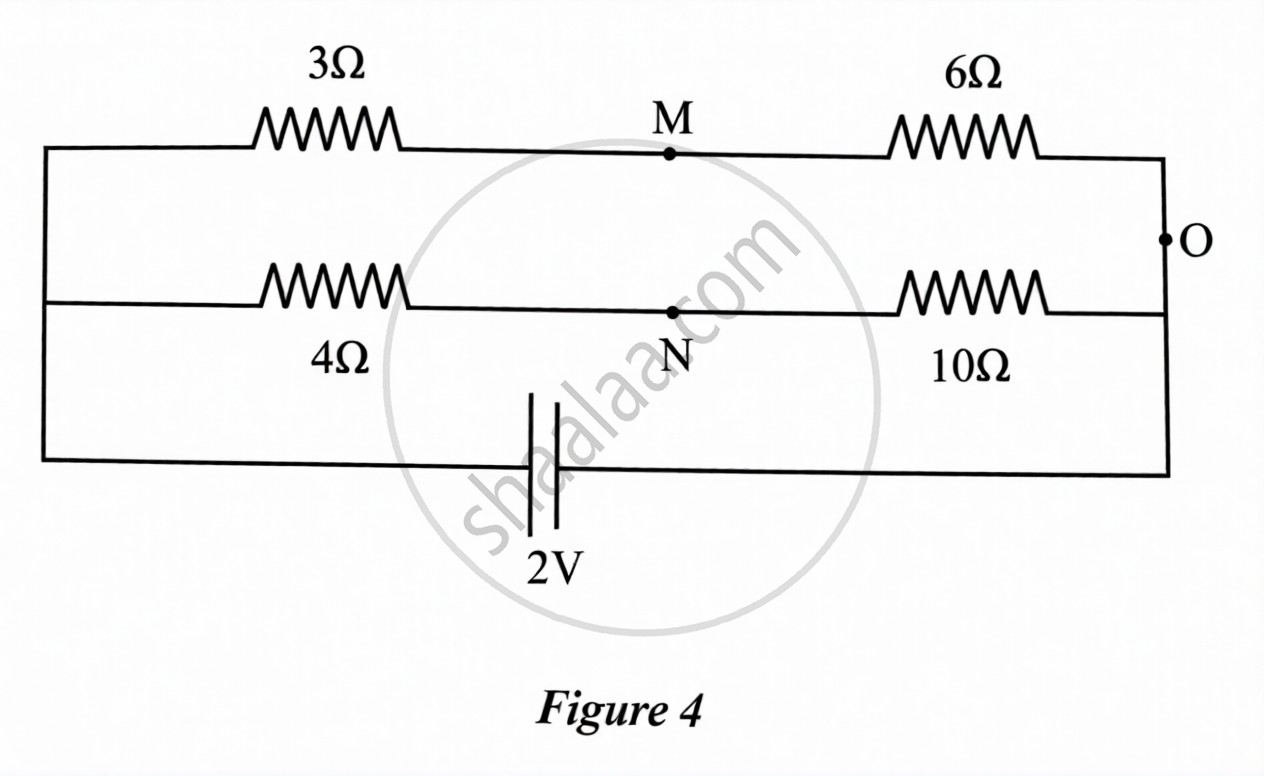
In the circuit shown in Figure 4 below, how much resistance should be connected to a 10 Ω resistor so that the points M and N are at the same potential?
Advertisements
उत्तर
For points M equal to the potential at point N (VM = VN), the circuit must satisfy the condition of a balanced Wheatstone bridge.
Let R1, R2, R3 and R4 be the resistors in the bridge:
R1 (Top left) = 3 Ω
R2 (Top right) = 6 Ω
R3 (Bottom left) = 4 Ω
R4 (Bottom right) = The target equivalent resistance for the 10 Ω branch.
`(R_1)/(R_2) = (R_3)/(R_4)`
`(3 Ω)/(6 Ω) = (4 Ω)/(R_4)`
`1/2 = (4 Ω)/(R_4)`
R4 = 8 Ω
To obtain a total resistance of 8 Ω from an existing 10 Ω resistor, another resistor (Rx) must be connected in parallel, since the required resistance is less than the given resistance.
Using the parallel resistance formula:
`1/(R_x) = 1/10 + 1/(R_p)`
`1/8= 1/10 + 1/(R_p)`
`1/(R_p) = 1/8 - 1/10`
= `(10 - 8)/80`
= `2/80`
= `1/40`
∴ Rp = 40 Ω
