Advertisements
Advertisements
प्रश्न
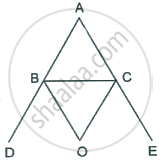
In the adjoining figure OB and OC are the bisectors of ∠DBC and ∠ECB, respectively. If AC > AB prove that OB > OC.
Advertisements
उत्तर
Given: A, B, C, D, E, O are as in the figure. OB bisects ∠DBC and OC bisects ∠ECB. AC > AB.
To Prove: OB > OC.
Proof [Step-wise]:
1. In triangle ABC,
AC > AB
⇒ ∠ABC > ∠ACB
2. Since D lies on the extension of BA beyond B, ∠DBC and ∠ABC are supplementary.
So, ∠DBC = 180° – ∠ABC.
Similarly ∠ECB = 180° − ∠ACB.
3. OB bisects ∠DBC,
So, `∠OBC = (1/2) ∠DBC = 90^circ - (1/2) ∠ABC`.
OC bisects ∠ECB,
So, `∠OCB = (1/2) ∠ECB = 90^circ - (1/2)∠ACB`.
4. From step 1,
∠ABC > ∠ACB
⇒ `(1/2) ∠ABC > (1/2) ∠ACB`
Hence, `90^circ - (1/2) ∠ABC < 90^circ - (1/2) ∠ACB`.
Therefore, ∠OBC < ∠OCB.
5. In triangle BOC, the larger side is opposite the larger angle.
Here, ∠OCB > ∠OBC.
So, the side opposite ∠OCB (which is OB) is greater than the side opposite ∠OBC (which is OC).
Therefore, OB > OC.
