Advertisements
Advertisements
प्रश्न
In the adjoining figure, BE = CD and ∠BEA = ∠CDA. Prove that AE = AD.
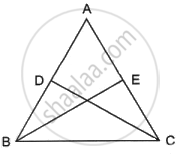
Advertisements
उत्तर
Given:
- In triangle ABC, points D on AB and E on AC are such that BE = CD and ∠BEA = ∠CDA.
To Prove:
- AE = AD.
Proof (Step-wise):
1. Let ℓ be the internal bisector of ∠A.
Reflect point D across ℓ and call its image E’ so E’ lies on AC.
Reflection across the angle bisector carries the side AB to AC and points on AB to points on AC.
2. By properties of reflection across an angle bisector:
AD = AE’ ...(Reflection preserves distance to A)
The image of the ray AB is the ray AC, so the image of the segment CD is a segment from C to E’.
In particular CD = BE’ the image of C under the same reflection is B and vice versa and the angle ∠CDA is carried to ∠BE'A.
Hence ∠BE’A = ∠CDA.
3. By (2), the reflected point E’ satisfies the two given conditions for E: BE’ = CD and ∠BE'A = ∠CDA.
The point E on AC given in the problem also satisfies those two conditions.
Since reflection across ℓ gives a unique image point of D on AC, the point E produced by the problem must coincide with the reflection E’ of D.
Therefore E = E’.
4. From step (2), we have AD = AE’ and from step (3) AE’ = AE.
Hence, AD = AE.
AE = AD, as required.
