Advertisements
Advertisements
प्रश्न
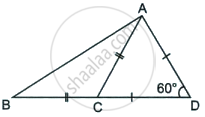
In the adjoining figure, AC = BC and CD = AD. If ∠ADC = 60°. Find ∠BAC.
Advertisements
उत्तर
Given:
- B, C, D are collinear with C between B and D.
- AC = BC and CD = AD.
- ∠ADC = 60°.
Step-wise calculation:
1. In triangle ADC, we have AD = CD and ∠ADC = 60°.
Therefore, the two base angles at A and C are equal and 2 × (base angle) + 60° = 180°.
⇒ Each base angle = 60°.
Hence, triangle ADC is equilateral.
So, AC = AD = CD. ...(Isosceles/equilateral angle facts used)
2. From AC = AD = CD and the given AC = BC, we get
BC = AC = CD
So, BC = CD.
Thus, C is the midpoint of BD (BC and CD are equal collinear segments).
3. At point C, the rays CB and CD are in opposite directions,
So ∠ACB + ∠ACD = 180°.
Since ∠ACD = 60° from the equilateral triangle,
∠ACB
= 180° – 60°
= 120°
4. In triangle ABC, the sides AC and BC are equal.
So, base angles at A and B are equal.
Let ∠BAC = ∠ABC = x.
Then x + x + 120° = 180°
⇒ 2x = 60°
⇒ x = 30°
⇒ ∠BAC = 30°.
