Advertisements
Advertisements
प्रश्न
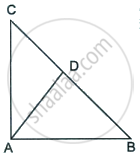
In the adjoining figure, ABC is a right-angled triangle, right-angled at A such that AB = AC. Bisector of ∠A meets BC at D. Prove that BC = 2AD.
Advertisements
उत्तर
Given: Triangle ABC is right-angled at A and AB = AC. The bisector of ∠A meets BC at D.
To Prove: BC = 2AD
Proof (Step-wise):
1. Let AB = AC = s (length s > 0).
Since ∠A = 90° and AB = AC, triangle ABC is an isosceles right triangle, so the base angles ∠B and ∠C are each 45°.
2. Place the triangle on a coordinate plane for a clear calculation:
Put A at the origin A(0, 0).
AB along the x-axis and AC along the y-axis.
Then B(s, 0) and C(0, s).
3. The angle bisector of ∠A which is 90° is the line at 45° through A, i.e., the line y = x.
The line BC has equation x + y = s, the line through (s, 0) and (0, s).
4. The intersection D of y = x and x + y = s satisfies 2x = s.
So, `x = s/2`.
Hence, `D = (s/2, s/2)`.
5. Compute lengths:
BC = Distance between B(s, 0) and C(0, s)
= `sqrt((s - 0)^2 + (0 - s)^2)`
= `s xx sqrt(2)`
AD = Distance from A(0, 0) to `D(s/2, s/2)`
= `sqrt((s/2)^2 + (s/2)^2)`
= `(s/2) xx sqrt(2)`
6. Compare:
`BC = s xx sqrt(2)`
= `2 xx (s/2) xx sqrt(2)`
= 2 × AD
Therefore, BC = 2AD, as required.
