Advertisements
Advertisements
प्रश्न
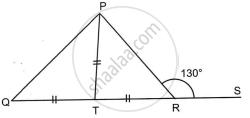
In ΔPQR, QR is produced to S so that ∠PRS = 130°. T is a point on QR so that PT = QT = TR. Find ∠QPR.
Advertisements
उत्तर
In ΔPQR, the side QR is produced to S and the exterior angle ∠PRS = 130°.
The angle ∠PRQ is supplementary to ∠PRS.
So, ∠PRQ = 180° – 130°
= 50°
We are given that T is a point on QR such that PT = QT = TR.
Consider ΔPTR.
Since PT = TR, it is an isosceles triangle.
The angles opposite the equal sides are equal:
∠TPR = ∠PRT = ∠PRQ = 50°
The sum of angles in ΔPTR is 180°.
So, ∠PTR = 180° – (∠TPR + ∠PRT)
= 180° – (50° + 50°)
= 80°
Consider ΔPTQ.
Since PT = QT, it is an isosceles triangle.
The angles opposite the equal sides are equal:
∠TPQ = ∠PQT = ∠PQR
The angle ∠PTR is the exterior angle for ΔPTQ at vertex T.
The exterior angle is the sum of the two opposite interior angles:
∠PTR = ∠TPQ + ∠PQT
80° = 2 × ∠PQT
∠PQT = 40°
And also, ∠TPQ = 40°.
The angle ∠QPR is the sum of ∠TPQ and ∠TPR:
∠QPR = ∠TPQ + ∠TPR
= 40° + 50°
= 90°
