Advertisements
Advertisements
प्रश्न
In a potentiometer experiment, the balancing length with a resistance of 2Ω is found to be 100 cm, while that of an unknown resistance is 500 cm. Calculate the value of the unknown resistance.
Advertisements
उत्तर
`R = 2 Ω`
`l_R = 100 "cm"`
`X = ?`
`l_X = 500 "cm"`
`therefore` by balancing bridge condition
`R/X = l_R/l_Y`
`2/X = 100/500`
`X = 10 Ω`
APPEARS IN
संबंधित प्रश्न
(i) State the principle on which a potentiometer works. How can a given potentiometer be made more sensitive?

Write two possible causes for one sided deflection in a potentiometer experiment.
Two students ‘X’ and ‘Y’ perform an experiment on potentiometer separately using the circuit given below:
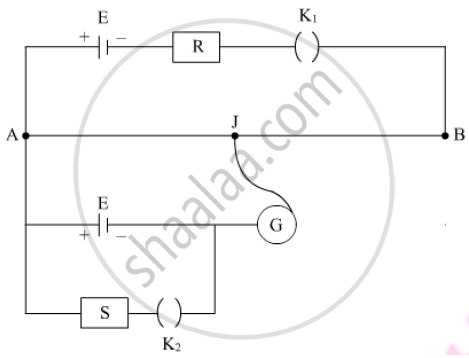
Keeping other parameters unchanged, how will the position of the null point be affected if
(i) ‘X’ increases the value of resistance R in the set-up by keeping the key K1 closed and the Key K2 opens?
(ii) ‘Y’ decreases the value of resistance S in the set-up, while the key K2 remains open and they K1 closed?
Justify.
A battery of emf 4 volt and internal resistance 1 Ω is connected in parallel with another battery of emf 1 V and internal resistance 1 Ω (with their like poles connected together). The combination is used to send current through an external resistance of 2 Ω. Calculate the current through the external resistance.
A voltmeter has a resistance of 100 Ω. What will be its reading when it is connected across a cell of emf 6 V and internal resistance 20 Ω?
The emf of a standard cell is 1.5V and is balanced by a length of 300 cm of a potentiometer with a 10 m long wire. Find the percentage error in a voltmeter that balances at 350 cm when its reading is 1.8 V.
A potentiometer wire has length L For given cell of emf E, the balancing length is `"L"/3` from 3 the positive end of the wire. If the length of the potentiometer wire is increased by 50%, then for the same cell, the balance point is obtained at length.
If the e.m.f of a cell is not constant in the metre bridge experiment, then the ____________.
A wire of resistance R is cut into two equal part. There parts are then connected in parallel. The equivalent resistance of the combination will be
1°C rise in temperature is observed in a conductor by passing a certain current. If the current is double then the rise in temperature is approximately.
