Advertisements
Advertisements
प्रश्न
In order to study and prove a particular physiological process in plants, the following experiment was set up. Study the same and then answer the question that follow:
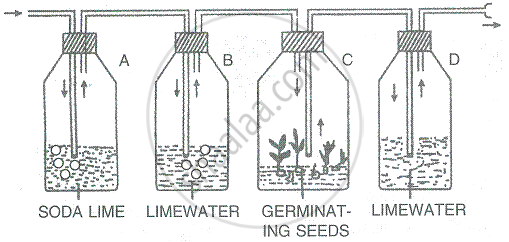
Represent the physiological process named in question 4.1 in the form of a chemical equation.
Advertisements
उत्तर
\[\ce{C6H12O6 + 6O2 -> 6CO2 + 6H2O + 38ATP (Energy)}\]
APPEARS IN
संबंधित प्रश्न
Describe one experiment you would perform to demonstrate the following phenomena: The germinating seeds produce heat.
Describe one experiment you would perform to demonstrate the following phenomena: The germinating seeds to give out carbon dioxide.
Describe one experiment each of you would perform to demonstrate the following phenomena: The germinating seeds can respire even in a total absence of air.
The following diagram refers to an apparatus which is used to demonstrate a physiological process:
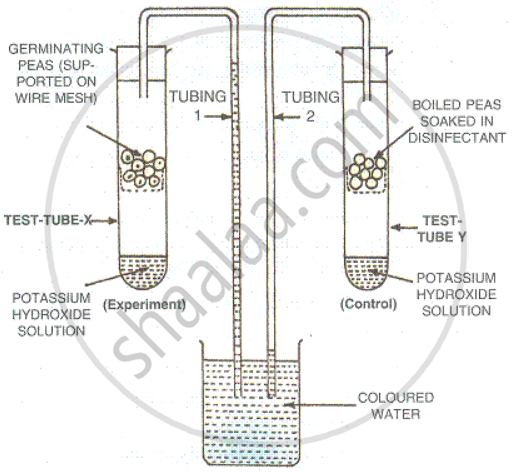
What is the purpose of keeping potassium hydroxide solution in test tubes X and Y?
The following diagram refers to an apparatus which is used to demonstrate a physiological process:
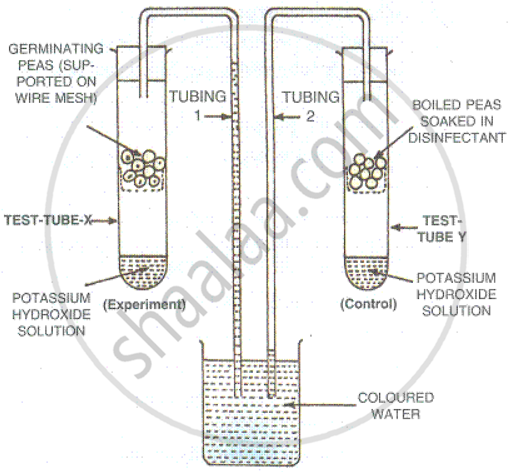
Why has the coloured water risen in tubing 1?
Given below is a set of six experimental set-ups (A-F), kept in this state for about 24 hours.
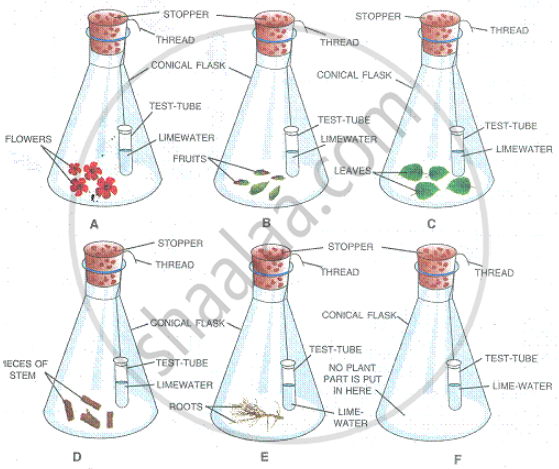
In how many flasks, the different plant parts have been kept under observation?
Given below is a set of six experimental set-ups (A-F), kept in this state for about 24 hours.
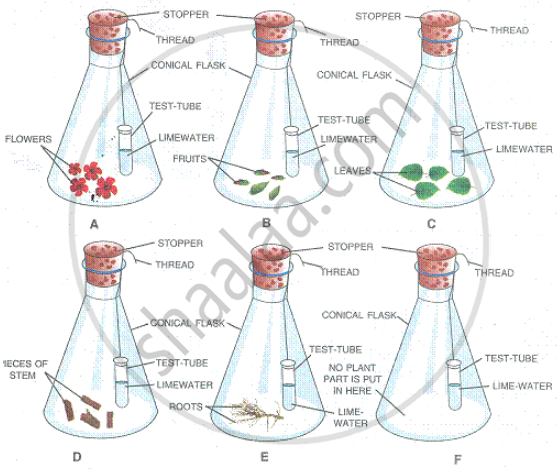
In which tube/tubes the limewater will turn milky?
In order to study and prove a particular physiological process in plants, the following experiment was set up. Study the same and then answer the question that follow:
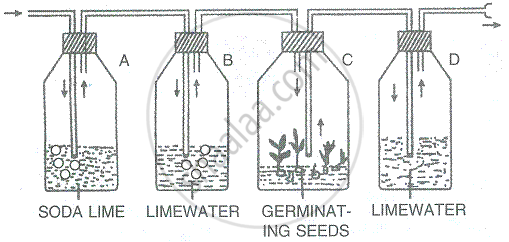
What change would you expect to observe in bottle 'D'?
Name the following:
The chemicals generally used to absorb carbon dioxide in respiratory experiments.
Name the following:
The solution that turns milky when carbon dioxide is passed through that solution.
