Advertisements
Advertisements
प्रश्न
In the given figure, diagonals AC and BD of quadrilateral ABCD intersect at O such that OB = OD. If AB = CD, then show that:
(i) ar (DOC) = ar (AOB)
(ii) ar (DCB) = ar (ACB)
(iii) DA || CB or ABCD is a parallelogram.
[Hint: From D and B, draw perpendiculars to AC.]

Advertisements
उत्तर
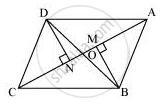
Let us draw DN ⊥ AC and BM ⊥ AC.
(i) In ΔDON and ΔBOM,
∠DNO = ∠BMO (By construction)
∠DON = ∠BOM (Vertically opposite angles)
OD = OB (Given)
By AAS congruence rule,
ΔDON ≅ ΔBOM
∴ DN = BM ... (1)
We know that congruent triangles have equal areas.
∴ Area (ΔDON) = Area (ΔBOM) ... (2)
In ΔDNC and ΔBMA,
∠DNC = ∠BMA (By construction)
CD = AB (Given)
DN = BM [Using equation (1)]
∴ ΔDNC ≅ ΔBMA (RHS congruence rule)
⇒ Area (ΔDNC) = Area (ΔBMA) ... (3)
On adding equations (2) and (3), we obtain
Area (ΔDON) + Area (ΔDNC) = Area (ΔBOM) + Area (ΔBMA)
Therefore, Area (ΔDOC) = Area (ΔAOB)
(ii) We obtained,
Area (ΔDOC) = Area (ΔAOB)
⇒ Area (ΔDOC) + Area (ΔOCB) = Area (ΔAOB) + Area (ΔOCB)
(Adding Area (ΔOCB) to both sides)
⇒ Area (ΔDCB) = Area (ΔACB)
(iii) We obtained,
Area (ΔDCB) = Area (ΔACB)
If two triangles have the same base and equal areas, then these will lie between the same parallels.
∴ DA || CB ... (4)
In ΔDOA and ΔBOC,
∠DOA = ∠BOC (Vertically opposite angles)
OD = OB (Given)
∠ODA = ∠OBC (Alternate opposite angles)
By ASA congruence rule,
ΔDOA ≅ ΔBOC
∴ DA = BC ... (5)
In quadrilateral ABCD, one pair of opposite sides is equal and parallel (AD = BC)
Therefore, ABCD is a parallelogram.
संबंधित प्रश्न
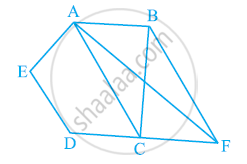
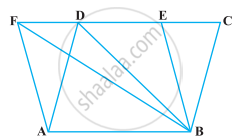
In the given figure, ABCDE is a pentagon. A line through B parallel to AC meets DC produced at F. Show that
(i) ar (ACB) = ar (ACF)
(ii) ar (AEDF) = ar (ABCDE)
ABCD is a trapezium with AB || DC. A line parallel to AC intersects AB at X and BC at Y. Prove that ar (ADX) = ar (ACY).
[Hint: Join CX.]
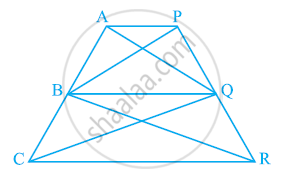
In the given figure, AP || BQ || CR. Prove that ar (AQC) = ar (PBR).
Diagonals AC and BD of a quadrilateral ABCD intersect at O in such a way that ar (AOD) = ar (BOC). Prove that ABCD is a trapezium.
In a ΔABC, P and Q are respectively the mid-points of AB and BC and R is the mid-point
of AP. Prove that :
(1) ar (Δ PBQ) = ar (Δ ARC)
(2) ar (Δ PRQ) =`1/2`ar (Δ ARC)
(3) ar (Δ RQC) =`3/8` ar (Δ ABC) .
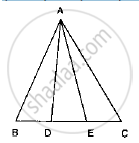
In the below fig. D and E are two points on BC such that BD = DE = EC. Show that ar
(ΔABD) = ar (ΔADE) = ar (ΔAEC).
In a ΔABC, if L and M are points on AB and AC respectively such that LM || BC. Prove
that:
(1) ar (ΔLCM ) = ar (ΔLBM )
(2) ar (ΔLBC) = ar (ΔMBC)
(3) ar (ΔABM) ar (ΔACL)
(4) ar (ΔLOB) ar (ΔMOC)
The area of the parallelogram ABCD is 90 cm2 (see figure). Find
- ar (ΔABEF)
- ar (ΔABD)
- ar (ΔBEF)
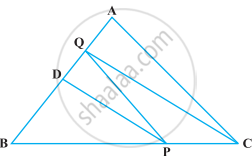
In ∆ABC, D is the mid-point of AB and P is any point on BC. If CQ || PD meets AB in Q (Figure), then prove that ar (BPQ) = `1/2` ar (∆ABC).
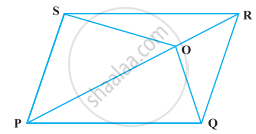
O is any point on the diagonal PR of a parallelogram PQRS (Figure). Prove that ar (PSO) = ar (PQO).