Advertisements
Advertisements
प्रश्न
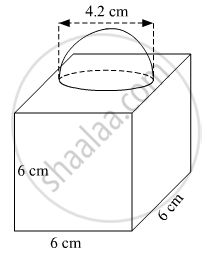
In Figure 3, a decorative block is shown which is made of two solids, a cube, and a hemisphere. The base of the block is a cube with an edge 6 cm and the hemisphere fixed on the top has a diameter of 4⋅2 cm. Find
(a) the total surface area of the block.
(b) the volume of the block formed. `("Take" pi = 22/7)`
Advertisements
उत्तर
(a) We need to find the total surface area of the block
Block excludes the base area of hemisphere
The surface area of the block×
` = "total surface area of cube + curved surface area of the hemisphere - a base area of hemisphere"`
total surface area of a cube= 6a2; a is a side of a cube
total surface area of cube = 6 × 62 = 216
Base area of hemisphere `pi"r"^2;` base is circular in shape
And curved surface area of hemisphere = `2pi"r"^2`
Total surface area of the block
`216 - pi"r"^2 + 2pi"r"^2`
`= 216 + pi"r"^2`
`= 216 + 22/7 xx ((4.2)/2)^2`
`= 216 + 22/7xx (17.64)/4`
`= 216 + 388.08/28`
`=229.86 "cm"^2`
(b) The volume of the block formed = volume of hemisphere+ volume of a cube
`=2/3 pi"r"^3 + "a"^3`
`= 2/3 xx 22/7 xx((4.2)/2)^2 + 6^3`
`= 2/3 xx 22/7 xx 4.41 + 216`
` = 194.04/21 + 216`
` = 225.24 "cm"^2`
