Advertisements
Advertisements
प्रश्न
In each of the following, determine whether the given values are solution of the given equation or not:
2x2 - x + 9 = x2 + 4x + 3; x = 2, x = 3
Advertisements
उत्तर
2x2 - x + 9 = x2 + 4x + 3; x = 2, x = 3
2x2 - x + 9 = x2 + 4x + 3
2x2 - x2 - x - 4x + (9 - 3) = 0
x2 + 5x + 6 = 0
Now x = 2
L.H.S. = (2)2 - 5 x 2 + 6 = 0
10 - 10 = 0 = R.H.S.
∴ x = 2 is a solution of the given equation.
On substituting x = 3 in L.H.S. of equation (1)
⇒ L.H.S. = (3)2 - 5 x 3 + 6
⇒ = 15 - 15
= 0
= R.H.S.
∴ x = 3 is a solution of the given equation.
संबंधित प्रश्न
A cottage industry produces a certain number of pottery articles in a day. It was observed on a particular day that the cost of production of each article (in rupees) was 3 more than twice the number of articles produced on that day. If the total cost of production on that day was Rs 90, find the number of articles produced and the cost of each article.
Solve:
(a + b)2x2 – (a + b)x – 6 = 0; a + b ≠ 0
Solve the following quadratic equation by factorisation.
2y2 + 27y + 13 = 0
The speed of an express train is x km/hr arid the speed of an ordinary train is 12 km/hr less than that of the express train. If the ordinary train takes one hour longer than the express train to cover a distance of 240 km, find the speed of the express train.
Solve the following by reducing them to quadratic equations:
`((7y - 1)/y)^2 - 3 ((7y - 1)/y) - 18 = 0, y ≠ 0`
Solve the following equation by factorization
x2 – (p + q)x + pq = 0
Solve the following equation by factorisation :
x(x + 1) + (x + 2)(x + 3) = 42
Car A travels ‘x’ km for every litre of petrol, while car B travels (x + 5) km for every litre of petrol.
- Write down the number of litres of petrol used by car A and car B in covering a distance of 400 km.
- If car A uses 4 litres of petrol more than car B in covering 400 km. write down an equation, in A and solve it to determine the number of litres of petrol used by car B for the journey.
In the centre of a rectangular lawn of dimensions 50 m × 40 m, a rectangular pond has to be constructed so that the area of the grass surrounding the pond would be 1184 m2 [see figure]. Find the length and breadth of the pond.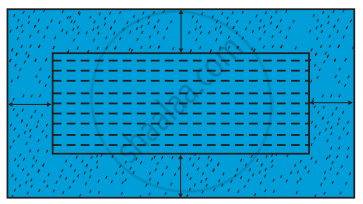
The product of two integers is –18; the integers are ______.
