Advertisements
Advertisements
प्रश्न
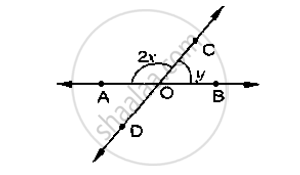
In the below fig, rays AB and CD intersect at O.
Determine y when x = 60°
Advertisements
उत्तर १
Given x = 60°
y = ?
`∠`AOC, `∠`BOC are linear pair of angles
`∠`AOC + `∠`BOC = 180°
⇒ 2x + y = 180°
⇒ 2 × 60 + y = 180° [ ∵x = 60°]
⇒ y = 180° -120°
⇒ y = 60°
उत्तर २
Rays ABand CD intersect at point O.
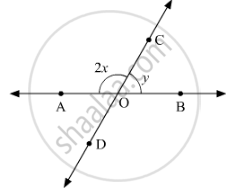
Therefore, ∠AOCand ∠BOCform a linear pair.
Thus,
∠AOC +∠BOC = 180°
2x +y =180° (1)
On substituting x = 60° :
2x + y = 180°
2(60°) + y = 180°
120° + y= 180°
y = 180°- 120°
y = 60°
APPEARS IN
संबंधित प्रश्न
How many pairs of adjacent angles are formed when two lines intersect in a point?
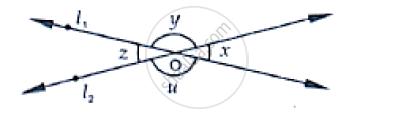
In the below fig, lines �1 and �2 intersect at O, forming angles as shown in the figure. If x = 45, Find the values of x, y, z and u.
Prove that the bisectors of a pair of vertically opposite angles are in the same straight line.
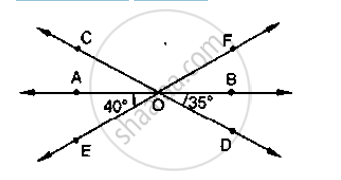
In the below fig, lines AB, CD and EF intersect at O. Find the measures of ∠AOC, ∠COF,
∠DOE and ∠BOF.
Give two examples of parallel lines you can see in your environment.
Give two examples of perpendicular lines you can see in your environment.
Two lines in a plane which do not meet at a point anywhere are called ______ lines.
What is the geometric relationship between two straight lines in the same plane that will never intersect, no matter how much they are extended?
In the example of a 'Zebra crossing,' what feature specifically exemplifies the constant distance property of parallel lines?
If the shortest distance between two straight lines in a plane is observed to change, what must be true about the lines?
