Advertisements
Advertisements
प्रश्न
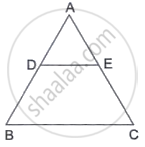
In an equilateral ∆ABC, D is the midpoint of AB and E is the midpoint of AC. Then, ar(∆ABC): ar(∆ADE) = ?
पर्याय
2 : 1
4 : 1
1 : 2
1 : 4
MCQ
Advertisements
उत्तर
4 : 1
Explanation:
Clearly, `(AD)/(AB) = (AE)/(AC) = 1/2` and ∠A = ∠A (common).
∴ ∆ABC ∼ ∆ADE ...[By SAS-similarity].
∴ `ar(∆ABC) : ar(∆ADE) = ((AB)/(AD))^2`
= `(2/1)^2`
= `4/1`
= 4 : 1
shaalaa.com
या प्रश्नात किंवा उत्तरात काही त्रुटी आहे का?
