Advertisements
Advertisements
प्रश्न
In ΔABC, PQ is perpendicular bisector of side AB and PR is perpendicular bisector of side BC.
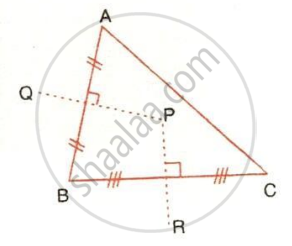
Statement (1): Perpendicular bisector of side AC will pass through point P.
Statement (2): Perpendicular bisectors of the sides of a triangle are concurrent.
पर्याय
Both the statements are true.
Both the statements are false.
Statement 1 is true, and statement 2 is false.
Statement 1 is false, and statement 2 is true.
Advertisements
उत्तर
Both the statements are true.
Explanation:
Since PQ is the perpendicular bisector of AB, any point on PQ is equidistant from A and B.
Similarly, since PR is the perpendicular bisector of BC, any point on PR is equidistant from B and C.
Therefore, point P, which lies on both PQ and PR, is equidistant from A, B and C.
This means that P is the center of a circle passing through A, B and C.
The perpendicular bisectors for sides AB, BC, and CA always meet at a single point called the circumcenter of ∆ ABC that is equidistant from all three vertices.
Thus, we can say that,
Perpendicular bisectors of sides of a triangle are concurrent.
So, statement 2 is true.
Consequently, the perpendicular bisector of AC must also pass through P, as P is equidistant from A and C.
So, statement 1 is true.
∴ Both the statements are true.
