Advertisements
Advertisements
प्रश्न
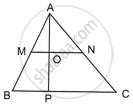
In ΔABC, M and N are mid-points of AB and AC respectively. P is any point on BC. Prove that MN bisects AP.
Advertisements
उत्तर
We are given a triangle ΔABC, where M and N are midpoints of sides AB and AC, respectively and P is a point on BC. We need to prove that line segment MN bisects segment AP.
Steps to prove that MN bisects AP:
1. Use the Midpoint Theorem: Since M and N are midpoints of sides AB and AC, respectively, by the Midpoint Theorem:
MN || BC and `MN = 1/2 BC`
This theorem states that the line segment joining the midpoints of two sides of a triangle is parallel to the third side and half its length.
2. Draw MP and NP: Let MP and NP be the line segments joining M and N to the point P on side BC.
3. Consider the properties of a trapezium: Since MN || BC, quadrilateral AMNP forms a trapezium, where MN || BC.
4. Proportions in the trapezium: In trapezium AMNP, the segment MN is parallel to BC and M and N are midpoints of sides AB and AC, respectively. Therefore, MN divides AP into two equal parts because the line joining the midpoint of two sides of a triangle divides the third side into two equal parts.
5. Conclusion: Since MN is parallel to BC and divides segment AP into two equal parts, we conclude that MN bisects AP.
Thus, we have proved that MN bisects AP.
