Advertisements
Advertisements
प्रश्न
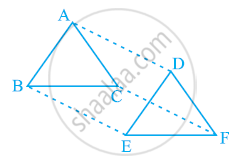
In ΔABC and ΔDEF, AB = DE, AB || DE, BC = EF and BC || EF. Vertices A, B and C are joined to vertices D, E and F respectively (see the given figure). Show that
(i) Quadrilateral ABED is a parallelogram
(ii) Quadrilateral BEFC is a parallelogram
(iii) AD || CF and AD = CF
(iv) Quadrilateral ACFD is a parallelogram
(v) AC = DF
(vi) ΔABC ≅ ΔDEF.
Advertisements
उत्तर
(i) It is given that AB = DE and AB || DE.
If two opposite sides of a quadrilateral are equal and parallel to each other, then it will be a parallelogram.
Therefore, quadrilateral ABED is a parallelogram.
(ii) Again, BC = EF and BC || EF
Therefore, quadrilateral BCEF is a parallelogram.
(iii) As we had observed that ABED and BEFC are parallelograms, therefore
AD = BE and AD || BE
(Opposite sides of a parallelogram are equal and parallel)
And, BE = CF and BE || CF
(Opposite sides of a parallelogram are equal and parallel)
∴ AD = CF and AD || CF
(iv) As we had observed that one pair of opposite sides (AD and CF) of quadrilateral ACFD are equal and parallel to each other, therefore, it is a parallelogram.
(v) As ACFD is a parallelogram, therefore, the pair of opposite sides will be equal and parallel to each other.
∴ AC || DF and AC = DF
(vi) ΔABC and ΔDEF,
AB = DE (Given)
BC = EF (Given)
AC = DF (ACFD is a parallelogram)
∴ ΔABC ≅ ΔDEF (By SSS congruence rule)
संबंधित प्रश्न
The angles of quadrilateral are in the ratio 3: 5: 9: 13. Find all the angles of the quadrilateral.
Show that if the diagonals of a quadrilateral bisect each other at right angles, then it is a rhombus.
Show that if the diagonals of a quadrilateral are equal and bisect each other at right angles, then it is a square.
The following statement are true and false .
If all the angles of a quadrilateral are equal, it is a parallelogram .
The perimeter of a parallelogram is 22 cm. If the longer side measures 6.5 cm, what is the measure of shorter side?
Complete the following statement by means of one of those given in brackets against each:
If one angle of a parallelogram is a right angle, then it is necessarily a .................
PQRS is a quadrilateral, PR and QS intersect each other at O. In which of the following case, PQRS is a parallelogram?
∠P =85°, ∠Q = 85°, ∠R = 95°
The figure formed by joining the mid-points of the adjacent sides of a quadrilateral is a
If one angle of a parallelogram is 24° less than twice the smallest angle, then the measure of the largest angle of the parallelogram is
The diagonals of a parallelogram ABCD intersect at O. If ∠BOC = 90° and ∠BDC = 50°, then ∠OAB =
