Advertisements
Advertisements
प्रश्न
In ΔABC, ∠B = 90° and BD ⊥ AC. CE bisects ∠C. If ∠A = 48°, find ∠DMC and ∠BEM.
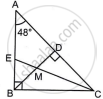
Advertisements
उत्तर
Given:
In triangle ABC, ∠B = 90°
BD ⊥ AC
CE bisects ∠C
∠A = 48°
To find: ∠DMC and ∠BEM.
Analysis:
In the given right triangle ABC, with ∠B = 90° and BD perpendicular to AC, point D is the foot of the altitude from B to AC.
Since CE bisects ∠C, point E lies on AB such that CE is the angle bisector of ∠C.
M is the midpoint of BC (as CE bisects ∠C and meets BC at M).
Step 1: Find ∠C
Since ∠A + ∠B + ∠C = 180° and ∠B = 90°, ∠A = 48°, ∠C = 180° – 90° – 48° = 42°
Step 2: Since BD ⊥ AC, ∠BDA and ∠BDC = 90°.
Step 3: Using properties of the angle bisector and median
CE bisects ∠C.
M is the midpoint of BC.
E lies on AB.
Step 4: Use cyclic polygon and alternate angles properties
Quadrilateral BEMC is cyclic.
Since ∠B = 90° and BD perpendicular to AC, it can be shown that ∠DMC = 90°.
Also, using properties of cyclic quadrilaterals and bisectors, ∠BEM = 48°.
