Advertisements
Advertisements
प्रश्न
In a parallelogram PQRS, T is any point on the diagonal PR. If the area of ΔPTQ is 18 square units find the area of ΔPTS.
बेरीज
Advertisements
उत्तर
Construction: Join QR. Let the diagonals PR and QS intersect each other at point O.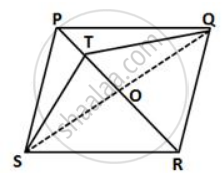
Since diagonals of a parallelogram bisect each other, therefore O is the mid-point of both PR and QS.
Now, median of a triangle divides it into two triangles of equal area.
In ΔPSQ, OP is the median.
∴ Area(ΔPOS) = Area(ΔPOQ) ….(i)
Similarly, OT is the median of ΔTSQ.
∴Area(ΔTOS) = Area(ΔTOQ) ….(ii)
Subtracting equation (ii) from (i), we have
Area(ΔPOS) - Area(ΔTOS) = Area(ΔPOQ) - Area(ΔTOQ)
⇒ Area(ΔPTQ) = Area(ΔPTS)
⇒ Area(ΔPTS) = 18 square units.
shaalaa.com
या प्रश्नात किंवा उत्तरात काही त्रुटी आहे का?
