Advertisements
Advertisements
प्रश्न
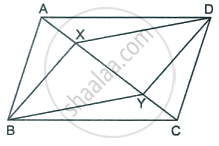
In a parallelogram ABCD; BX is the bisector of ∠ABC and DY is the bisector of ∠ADC. Prove that BXDY is a parallelogram.
Advertisements
उत्तर
Given: ABCD is a parallelogram. BX is the bisector of ∠ABC meeting AD at X. DY is the bisector of ∠ADC meeting BC at Y.
To Prove: Quadrilateral BXDY is a parallelogram.
Proof [Step-wise]:
1. In parallelogram ABCD, opposite sides are parallel:
AB || CD and AD || BC
2. Opposite angles of a parallelogram are equal.
So, ∠ABC = ∠ADC.
3. BX bisects ∠ABC,
So, `∠ABX = 1/2 ∠ABC`.
DY bisects ∠ADC,
So, `∠CDY = 1/2 ∠ADC`.
From step 2,
`1/2 ∠ABC = 1/2 ∠ADC`
Hence, ∠ABX = ∠CDY.
4. AB || CD (step 1).
Because BX makes the same angle with AB that DY makes with CD and AB || CD, it follows that BX || DY if two lines make equal angles with two parallel lines, the two lines are parallel.
5. By construction X lies on AD, so XD is collinear with AD.
Y lies on BC, so YB is collinear with BC.
Since AD || BC (step 1), we have XD || BY.
6. From steps 4 and 5, we have both pairs of opposite sides of quadrilateral BXDY parallel BX || DY and XD || BY.
Therefore, BXDY is a parallelogram.
