Advertisements
Advertisements
प्रश्न
If y is the mean proportional between x and y; show that y(x+z) is the mean p roporti ona I between x2+ y2 and y2+ z2
Advertisements
उत्तर
Since y is the mean proportion between x and z
Therefore, y2=xz
Now, we have to prove that xy+yz is the mean proportional between x2+y2 and y2+z2.
(xy + yz)2 = (x2 + y2)(y2 + z2)
LHS = (xy + yz)2
= [y (x + z)]2
= y2(x + z)2
= xz (x + z)2
RHS = (x2 + y2)(y2 + z2)
= (x2 + xz) (xz+ z2)
= x (x + z) z (x + z)
= xz (x + z)2
LHS = RHS
APPEARS IN
संबंधित प्रश्न
If `x/a = y/b = z/c` prove that `(2x^3 - 3y^3 + 4z^3)/(2a^3 - 3b^3 + 4c^3) = ((2x - 3y + 4z)/(2a - 3b + 4c))^3`
Find two numbers such that the mean proportional between them is 14 and third proportional to them is 112.
If ( a+c) : b = 5 : 1 and (bc + cd) : bd = 5 : 1, then prove that a : b = c : d
Find the fourth proportional to:
2xy, x2, y2
If q is the mean proportional between p and r, prove that
`p^2 - q^2 + r^2 = q^4[(1)/p^2 - (1)/q^2 + (1)/r^2]`.
If 9 kg of rice costs Rs 327.60, what will be the cost of 50 kg of rice?
The cost of 18 chairs is Rs 22770. How many such chairs can be bought for Rs 10120?
A car travels 90 km in 3 hours with constant speed. It will travel 140 km in 5 hours at the same speed
Unequal masses will not balance on a fulcrum if they are at equal distance from it; one side will go up and the other side will go down.
Unequal masses will balance when the following proportion is true:
`("mass"1)/("length"2) = ("mass"2)/("length"1)`

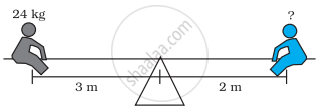
Two children can be balanced on a seesaw when
`("mass"1)/("length"2) = ("mass"2)/("length"1)`. The child on the left and child on the right are balanced. What is the mass of the child on the right?
If x, 2, 10 and y are in continued proportion, the values of x and y are respectively:
