If the squared difference of the zeros of the quadratic polynomial f(x) = x^2 + px + 45 is equal to 144, find the value of p.
Advertisements
प्रश्न
If the squared difference of the zeros of the quadratic polynomial f(x) = x2 + px + 45 is equal to 144, find the value of p.
Advertisements
उत्तर
Given α and β are the zeros of the quadratic polynomial f(x) = x2 + px + 45
`alpha+beta=-"coefficient of x"/("coefficient of "x^2)`
`=(-p)/1`
= -p
`alphabeta="constant term"/("coefficient of "x^2)`
`=45/1`
= 45
we have,
`(alpha-beta)^2=alpha^2+beta^2-2alphabeta`
`144=(alpha+beta)^2-2alphabeta-2alphabeta`
`144=(alpha+beta)^2-4alphabeta`
Substituting `alpha+beta=-p " and "alphabeta=45`
then we get,
`144=p^2-4xx45`
`144=p^2-180`
`p^2=144+180`
`p^2=324`
`p=+-sqrt(324)`
`p=+-18`
Hence, the value of p is ±18.
APPEARS IN
संबंधित प्रश्न
Find all zeroes of the polynomial `(2x^4 - 9x^3 + 5x^2 + 3x - 1)` if two of its zeroes are `(2 + sqrt3)` and `(2 - sqrt3)`
If a and 3 are the zeros of the quadratic polynomial f(x) = x2 + x − 2, find the value of `1/alpha-1/beta`.
If one zero of the quadratic polynomial f(x) = 4x2 – 8kx – 9 is negative of the other, find the value of k.
If α and β are the zeros of the quadratic polynomial f(x) = x2 – p(x + 1) – c, show that (α + 1)(β + 1) = 1 – c.
Find the quotient and the remainder when f(x) = x4 – 5x + 6 is divided by g(x) = 2 – x2.
If α, β are the zeroes of the polynomial f(x) = x2 + x – 2, then `(α/β - α/β)`.
What should be added to the polynomial x2 − 5x + 4, so that 3 is the zero of the resulting polynomial?
Case Study -1
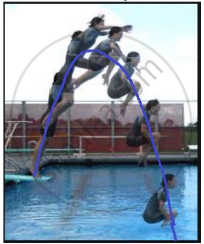
The figure given alongside shows the path of a diver, when she takes a jump from the diving board. Clearly it is a parabola.
Annie was standing on a diving board, 48 feet above the water level. She took a dive into the pool. Her height (in feet) above the water level at any time ‘t’ in seconds is given by the polynomial h(t) such that h(t) = -16t2 + 8t + k.
The zeroes of the polynomial r(t) = -12t2 + (k - 3)t + 48 are negative of each other. Then k is ______.
An asana is a body posture, originally and still a general term for a sitting meditation pose, and later extended in hatha yoga and modern yoga as exercise, to any type of pose or position, adding reclining, standing, inverted, twisting, and balancing poses. In the figure, one can observe that poses can be related to representation of quadratic polynomial.


The zeroes of the quadratic polynomial `4sqrt3"x"^2 + 5"x" - 2sqrt3` are:
A quadratic polynomial, whose zeroes are –3 and 4, is ______.
If two of the zeroes of a cubic polynomial are zero, then it does not have linear and constant terms.
Given that the zeroes of the cubic polynomial x3 – 6x2 + 3x + 10 are of the form a, a + b, a + 2b for some real numbers a and b, find the values of a and b as well as the zeroes of the given polynomial.
Find the zeroes of the following polynomials by factorisation method and verify the relations between the zeroes and the coefficients of the polynomials:
`v^2 + 4sqrt(3)v - 15`
A quadratic polynomial the sum and product of whose zeroes are – 3 and 2 respectively, is ______.
If p(x) = x2 + 5x + 6, then p(– 2) is ______.
A quadratic polynomial whose sum and product of zeroes are 2 and – 1 respectively is ______.
For the quadratic equation \[ ax^{2} + bx + c = 0 \] with roots \[ \alpha, \beta \], the sum of the roots \( \alpha + \beta \) equals:
For the cubic equation \[ ax^{3} + bx^{2} + cx + d = 0 \] with roots \[ \alpha, \beta, \gamma \], the product of the roots \( \alpha\beta\gamma \) equals:
A quadratic equation whose roots are \[ \alpha, \beta \] can be written as:
If a quadratic equation \[ ax^{2} + bx + c = 0 \] has roots \[ \alpha = 2 \] and \[ \beta = 3 \], which equation has exactly these roots?
