Advertisements
Advertisements
प्रश्न
If the height of a tower and the distance of the point of observation from its foot, both, are increased by 10%, then the angle of elevation of its top remains unchanged.
पर्याय
True
False
Advertisements
उत्तर
This statement is True.
Explanation:
Case (i): Let the height of a tower be h and the distance of the point of observation from its foot is x.
In ∆ABC,
tan θ1 = `"AC"/"BC" = "h"/x` ...(i)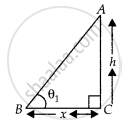
Case (ii): Now, the height of a tower increased by 10%
= h + 10% of h
= `"h" + "h" * 10/100`
= `(11"h")/100`
And the distance of the point of observation from its foot
= x + 10% of x
= `x + x xx 10/100 = (11x)/10`
In ΔPQR,
tan θ2 = `"PR"/"QR" = (((11"h")/10))/(((11x)/10))`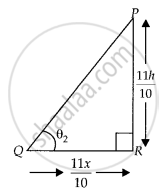
⇒ tan θ2 = `"h"/x` ...(ii)
From equations (i) and (ii), we get
tan θ1 = tan θ2
⇒ θ1 = θ2
Hence, the required angle of elevation of its top remains unchanged.
