Advertisements
Advertisements
प्रश्न
If P is any point on the hyperbola whose axis are equal, prove that SP. S'P = CP2.
Advertisements
उत्तर
Equation of the hyperbola: \[\frac{x^2}{a^2} - \frac{y^2}{b^2} = 1\]
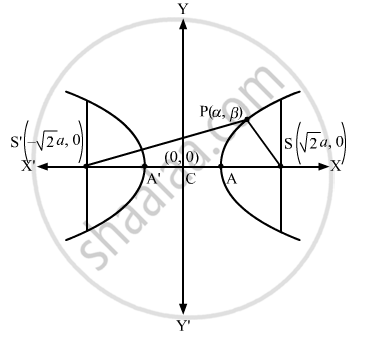
If the axes of the hyperbola are equal, then \[a = b\].
Then, equation of the hyperbola becomes \[x^2 - y^2 = a^2\].
\[\therefore b^2 = a^2 \left( e^2 - 1 \right)\]
\[ \Rightarrow a^2 = a^2 \left( e^2 - 1 \right)\]
\[ \Rightarrow 1 = \left( e^2 - 1 \right)\]
\[ \Rightarrow e^2 = 2\]
\[ \Rightarrow e = \sqrt{2}\]
Thus, the centre \[C\left( 0, 0 \right)\] and the focus are given by \[S\left( \sqrt{2}a, 0 \right)\] and \[S'\left( - \sqrt{2}a, 0 \right)\], respectively.
Let
\[P\left( \alpha, \beta \right)\] be any point on the parabola.
So, it will satisfy the equation.
\[\alpha^2 - \beta^2 = a^2\]
\[\therefore S P^2 = \left( \sqrt{2}a - \alpha \right)^2 + \beta^2 \]
\[ = 2 a^2 + \alpha^2 - 2\sqrt{2}a\alpha + \beta^2\]
\[S' P^2 = \left( - \sqrt{2}a - \alpha \right)^2 + \beta^2 \]
\[ = 2 a^2 + \alpha^2 + 2\sqrt{2}a\alpha + \beta^2\]
Now, \[S P^2 . S' P^2 = \left( 2 a^2 + \alpha^2 - 2\sqrt{2}a\alpha + \beta^2 \right)\left( 2 a^2 + \alpha^2 + 2\sqrt{2}a\alpha + \beta^2 \right)\]
\[ = 4 a^4 + 4 a^2 \left( \alpha^2 + \beta^2 \right) + \left( \alpha^2 + \beta^2 \right)^2 - 8 a^2 \alpha^2 \]
\[ = 4 a^2 \left( a^2 - 2 \alpha^2 \right) + 4 a^2 \left( \alpha^2 + \beta^2 \right) + \left( \alpha^2 + \beta^2 \right)^2 \]
\[ = 4 a^2 \left( \alpha^2 - \beta^2 - 2 \alpha^2 \right) + 4 a^2 \left( \alpha^2 + \beta^2 \right) + \left( \alpha^2 + \beta^2 \right)^2 \]
\[ = - 4 a^2 \left( \alpha^2 + \beta^2 \right) + 4 a^2 \left( \alpha^2 + \beta^2 \right) + \left( \alpha^2 + \beta^2 \right)^2 \]
\[ = \left( \alpha^2 + \beta^2 \right)^2 \]
\[ = C P^4 \]
APPEARS IN
संबंधित प्रश्न
Find the equation of the hyperbola satisfying the given conditions:
Vertices (0, ±5), foci (0, ±8)
Find the equation of the hyperbola satisfying the given conditions:
Foci (±5, 0), the transverse axis is of length 8.
The equation of the directrix of a hyperbola is x − y + 3 = 0. Its focus is (−1, 1) and eccentricity 3. Find the equation of the hyperbola.
Find the equation of the hyperbola whose focus is (1, 1) directrix is 2x + y = 1 and eccentricity = \[\sqrt{3}\].
Find the equation of the hyperbola whose focus is (2, −1), directrix is 2x + 3y = 1 and eccentricity = 2 .
Find the eccentricity, coordinates of the foci, equation of directrice and length of the latus-rectum of the hyperbola .
16x2 − 9y2 = −144
Find the eccentricity, coordinates of the foci, equation of directrice and length of the latus-rectum of the hyperbola .
4x2 − 3y2 = 36
Find the equation of the hyperbola, referred to its principal axes as axes of coordinates, in the conjugate axis is 7 and passes through the point (3, −2).
Find the equation of the hyperbola whose foci are (6, 4) and (−4, 4) and eccentricity is 2.
Find the equation of the hyperbola whose foci are (4, 2) and (8, 2) and eccentricity is 2.
Find the equation of the hyperbola whose vertices are at (0 ± 7) and foci at \[\left( 0, \pm \frac{28}{3} \right)\] .
Find the equation of the hyperbola whose foci at (± 2, 0) and eccentricity is 3/2.
Find the equation of the hyperbola satisfying the given condition :
vertices (0, ± 5), foci (0, ± 8)
Find the equation of the hyperbola satisfying the given condition :
vertices (0, ± 3), foci (0, ± 5)
find the equation of the hyperbola satisfying the given condition:
vertices (± 7, 0), \[e = \frac{4}{3}\]
Find the equation of the hyperbola satisfying the given condition:
foci (0, ± \[\sqrt{10}\], passing through (2, 3).
Show that the set of all points such that the difference of their distances from (4, 0) and (− 4,0) is always equal to 2 represents a hyperbola.
Write the equation of the hyperbola whose vertices are (± 3, 0) and foci at (± 5, 0).
The difference of the focal distances of any point on the hyperbola is equal to
The foci of the hyperbola 9x2 − 16y2 = 144 are
The equation of the hyperbola whose centre is (6, 2) one focus is (4, 2) and of eccentricity 2 is
Find the equation of the hyperbola whose vertices are (± 6, 0) and one of the directrices is x = 4.
The eccentricity of the hyperbola `x^2/a^2 - y^2/b^2` = 1 which passes through the points (3, 0) and `(3 sqrt(2), 2)` is ______.
If the distance between the foci of a hyperbola is 16 and its eccentricity is `sqrt(2)`, then obtain the equation of the hyperbola.
Find the eccentricity of the hyperbola 9y2 – 4x2 = 36.
Find the equation of the hyperbola with eccentricity `3/2` and foci at (± 2, 0).
Show that the set of all points such that the difference of their distances from (4, 0) and (– 4, 0) is always equal to 2 represent a hyperbola.
Find the equation of the hyperbola with vertices (± 5, 0), foci (± 7, 0)
The locus of the point of intersection of lines `sqrt(3)x - y - 4sqrt(3)k` = 0 and `sqrt(3)kx + ky - 4sqrt(3)` = 0 for different value of k is a hyperbola whose eccentricity is 2.
The eccentricity of the hyperbola whose latus rectum is 8 and conjugate axis is equal to half of the distance between the foci is ______.
