Advertisements
Advertisements
प्रश्न
How will you describe the position of a table lamp on your study table to another person?
Advertisements
उत्तर १
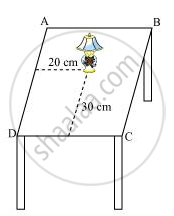
Consider that the lamp is placed on the table. Choose two adjacent edges, DC and AD. Then, draw perpendiculars on the edges of DC and AD from the position of the lamp and measure the lengths of these perpendiculars. Let the length of these perpendiculars be 30 cm and 20 cm, respectively. Now, the position of the lamp from the left edge (AD) is 20 cm and from the lower edge (DC) is 30 cm. This can also be written as (20, 30), where 20 represents the perpendicular distance of the lamp from edge AD and 30 represents the perpendicular distance of the lamp from edge DC.
उत्तर २
To describe the position of a mobile phone kept on the study table, we take two lines, a perpendicular and a horizontal line.
Considering the table as a plane(x and y axis) and taking perpendicular line as Y axis and horizontal as X axis respectively. Take one corner of table as origin where both X and Y axes intersect each other. Now, the length of table is Y axis and breadth is X axis. From The origin, join the line to the mobile phone and mark a point. The distances of the point from both the X and Y axes should be calculated and then written in terms of coordinates.
Let the distance of the point from X- axis and Y- axis is x and y respectively, so the mobile phone will be in (x, y) coordinate.
APPEARS IN
संबंधित प्रश्न
Show that A(-4, -7), B(-1, 2), C(8, 5) and D(5, -4) are the vertices of a
rhombus ABCD.
The points \[A \left( x_1 , y_1 \right) , B\left( x_2 , y_2 \right) , C\left( x_3 , y_3 \right)\] are the vertices of ΔABC .
(i) The median from A meets BC at D . Find the coordinates of the point D.
(ii) Find the coordinates of the point P on AD such that AP : PD = 2 : 1.
(iii) Find the points of coordinates Q and R on medians BE and CF respectively such thatBQ : QE = 2 : 1 and CR : RF = 2 : 1.
(iv) What are the coordinates of the centropid of the triangle ABC ?
If the points A(−2, 1), B(a, b) and C(4, −1) ae collinear and a − b = 1, find the values of aand b.
\[A\left( 6, 1 \right) , B(8, 2) \text{ and } C(9, 4)\] are three vertices of a parallelogram ABCD . If E is the mid-point of DC , find the area of \[∆\] ADE.
Write the coordinates of a point on X-axis which is equidistant from the points (−3, 4) and (2, 5).
Find the coordinates of the point which is equidistant from the three vertices A (\[2x, 0) O (0, 0) \text{ and } B(0, 2y) of ∆\] AOB .
The ratio in which the line segment joining points A (a1, b1) and B (a2, b2) is divided by y-axis is
Students of a school are standing in rows and columns in their playground for a drill practice. A, B, C and D are the positions of four students as shown in figure. Is it possible to place Jaspal in the drill in such a way that he is equidistant from each of the four students A, B, C and D? If so, what should be his position?
If the coordinates of the two points are P(–2, 3) and Q(–3, 5), then (abscissa of P) – (abscissa of Q) is ______.
A tiling or tessellation of a flat surface is the covering of a plane using one or more geometric shapes, called tiles, with no overlaps and no gaps. Historically, tessellations were used in ancient Rome and in Islamic art. You may find tessellation patterns on floors, walls, paintings etc. Shown below is a tiled floor in the archaeological Museum of Seville, made using squares, triangles and hexagons.

A craftsman thought of making a floor pattern after being inspired by the above design. To ensure accuracy in his work, he made the pattern on the Cartesian plane. He used regular octagons, squares and triangles for his floor tessellation pattern

Use the above figure to answer the questions that follow:
- What is the length of the line segment joining points B and F?
- The centre ‘Z’ of the figure will be the point of intersection of the diagonals of quadrilateral WXOP. Then what are the coordinates of Z?
- What are the coordinates of the point on y-axis equidistant from A and G?
OR
What is the area of Trapezium AFGH?
