Advertisements
Advertisements
प्रश्न
How is Maslow’s Theory related with the Herzberg’s Theory?
Explain the relationship between Maslow’s Theory and Herzberg’s Theory of Motivation.
Advertisements
उत्तर
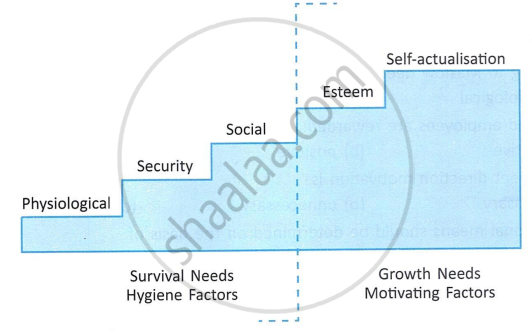
Maslow and Herzberg's theories share numerous similarities. Both models assume that unique needs motivate behaviour. Both fail to address individual motivational variations. Both oversimplify the motivational process by focussing on the same problem and relationships. As shown in Figure, the maintenance elements mostly meet lower-level (physiological, security, and social) demands. Motivators can help meet higher-level demands (ego and self-actualization). Both models focus on the same relationship, that is, what motivates an individual. In rich nations, most lower-level wants are met, while higher-level demands function as motivators. This is what Herzberg advised. Lower-level requirements, on the other hand, remain unfulfilled in developing countries and hence continue to serve as motivators. According to Herzberg, these are dissatisfactory and do not motivate employees. Thus, Herzberg's model complements the need hierarchy theory. Herzberg's framework is more appropriate to persons who have met their basic needs. Maslow's theory has a broader application because it proposed that any unsatisfied need, whether at the lower or higher levels, will motivate people.