Advertisements
Advertisements
प्रश्न
Have there been any changes near your area, which may be difficult to call ‘progress’? What changes are these? What are the different opinions about them?
Advertisements
उत्तर
Yes, there are many changes that may not be called progress in the real sense. Let us take the example of a growing number of vehicles on the road. More vehicles have made travel easier but it is also leading to air pollution. Similarly, many factories are coming up near some cities and villages.
These factories produce goods for people but they also create a lot of air and water pollution. Some machines have been invented which can do the job of thousands of people and thus make thousands of people jobless. Many gadgets in our home have made us dependent on them. We are becoming more lethargic.
APPEARS IN
संबंधित प्रश्न
Are rotis made in your home? From which grains are they made?
In your house what is done to protect grains and pulses from insects?
Find out about the crops - cereals, vegetables, pulses - that are grown in your area. Of those, is there anything that is famous across the country?
Hasmukh said, “With profits from our fields, we can progress.” What is your understanding of ‘progress’?
What kind of progress would you like to see in your area?
What can happen to Hasmukh’s farm after some years?
What questions come to your mind about farmers and farming? Write some questions in your group and ask a farmer. For example, how many crops do they grow in a year? Which crop needs how much water?
Visit a farm near your area. Observe and talk to the people there. Write a report.
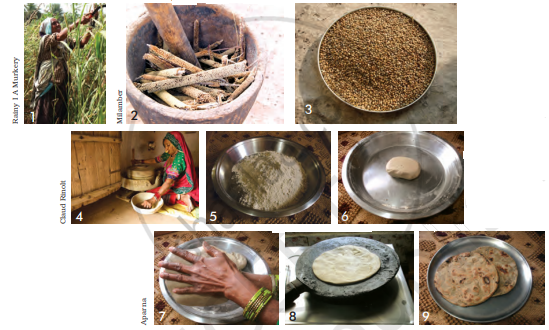
What can you see in each picture on the next page?
In picture 2 you can see the bajra cobs in the mortar (okhli, used for crushing). The cobs are crushed with a pestle (moosli) and the seeds are separated from the cob. You can see the separated seeds in picture 3. Now this work is also done by big machines, like threshers. We call both these different ‘technologies’ – using our hands or big machines – to crush the seeds.
What technology could have been used to cut the stem in picture 1? What do you think is being done in the grinder (chakki ) in picture 4? What ways (technologies) would have been used to do the work shown in pictures 5 and 6? You can see that the dough is ready in picture 6. When do you think a sieve (chhalni ) would have been used? Discuss each step in detail, in any language you wish to use.
There have been many changes over time, in our food. What can this mean? Use the seed story and what you know from your elders to explain.
