Advertisements
Advertisements
प्रश्न
Grandmother’s prophecy was that the tiger
Mark the right answer.
पर्याय
would prefer Mahmoud’s bed to sleep in
and the cook would disappear together from the house.
would one day make a meal of Mahmoud.
Advertisements
उत्तर
Grandmother’s prophecy was that the tiger would one day make a meal of Mahmoud.
संबंधित प्रश्न
Why does he break down in tears after the fire?
Pick out word from the text that mean the same as the following word or expression. (Look in the paragraph indicated.)
the usual way of doing things : _________
Look for information on how to find out whether a snake is harmful.
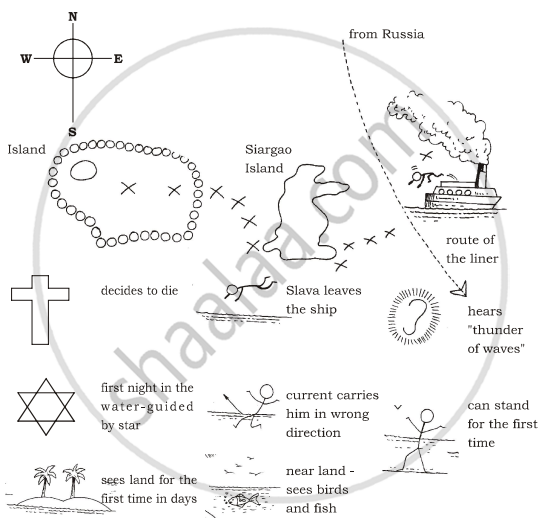
Given below is a map of the area in which Slava Kurilov faced his ordeal. You will also see the major events in the story, in mixed order, each accompanied by a symbol. After you have read ‘Ordeal in the Ocean’, draw the appropriate symbol against each x mark. (One is already drawn for you.) Draw the symbols or number the symbols, and transfer them to the map.)
Read the English folktale given below and fill up the blank spaces with suitable words.
There were once three tortoises – a father, a mother (a) ________. a baby (b) ________ one fine morning during Spring, they decided (c) ________ picnic. They picked the place (d) ________ they would go; a nice wood at some distance, (e) ________ they began to put their things together. They got tins of cheese, vegetables, meat and fruit preserves. In about three months, they were ready. They set out carrying their baskets (f) ________ eighteen months, they sat down for a rest. They knew (g) ________ they were already half way to the picnic place.
In three years they reached there. They unpacked (h) ________ spread out the canned food. Then, mother began to search inside the basket. She turned it upside down and shook it (i) ________ something important was missing.
“We’ve forgotten the tin-opener. Baby, you’ll have to go back. We can’t start without a tin-opener. We’ll wait for you”. .
“Do you promise (j) ________ you won’t touch a thing (k) ________ I come back?”
“Yes, we promise faithfully,” Mother and father said together.
Soon after, he was lost among the bushes.
So, they waited and waited. A year went by and they were getting hungry. They had promised (l) ________ they waited. They began to feel really hungry (m) ________ the sixth year was about to end.
Mother tortoise said, “He’d never know the difference.” “No,” said the father tortoise.
Mother tortoise said, “He ought to be back by now. Let’s just have one sandwich (n) ________ we are waiting.”
They picked up the sandwiches, (o) ________ as they were going to eat them, a little voice said, “Aha! I knew you’d cheat! It’s a good thing I didn’t start for that tin opener,” baby Tortoise said.
Some are meet for a maiden's wrist,
Silver and blue as the mountain mist,
Some are flushed like the buds that dream
On the tranquil brow of a woodland stream,
Some are aglow with the bloom that cleaves
To the limpid glory of new born leaves
Read the lines given above and answer the question that follow.
Mention the colours that are given or hinted at to describe the bangles.
Abou Ben Adhem (may his tribe increase!)
Awoke one night from a deep dream of peace,
And saw, within the moonlight in his room,
Making it rich, and like a lily in bloom,
An angel writing in a book of gold:-
Read the lines given above and answer the following question.
What did Ben Adhem see one night in his room, when he was awakened?
Unleashing the goats from the drumstick tree, Muni started out, driving them ahead and uttering weird cries from time to time in order to urge them on. Me passed through the village with his head bowed in thought. He did not want to look at anyone or be accosted. A couple of cronies lounging in the temple corridor hailed him, but he ignored their call. They had known him in the days of affluence when he lorded over a flock of fleecy sheep, not the miserable grawky goats that he had today.
Read the extract given below and answer the question that follow.
Describe Muni’s prosperous times.
What was the king’s reaction when he came to know that he had lost the challenge?
Where did Mr Gessler live?
What was unique about the Great Glass Elevator?
This pahalwan had but one shortcoming. What was that?
Who do you think or understand what the talking fan wished to convey?
Do you find the poem humorous? Read aloud lines which make you laugh.
Answer the following question. (Refer to that part of the text whose number is given against the question. This applies to the comprehension questions throughout the book.)
How did Patrick help him? (7)
With your partner try to guess the meaning of the underlined phrase.
The afternoon turned black.
Read the newspaper report to find the following facts about Columbia’s ill-fated voyage.
Number of experiments done by scientists: ____________
Multiple Choice Question:
Which of the following words means opposite to punished’?
Find out the meaning of the following words by looking them up in the dictionary. Then use them in sentences of your own.
comical
What suggestions were made in answer to the third question?
