Advertisements
Advertisements
प्रश्न
Given: sin θ = `p/q`, find cos θ + sin θ in terms of p and q.
Advertisements
उत्तर १
Consider the diagram below :
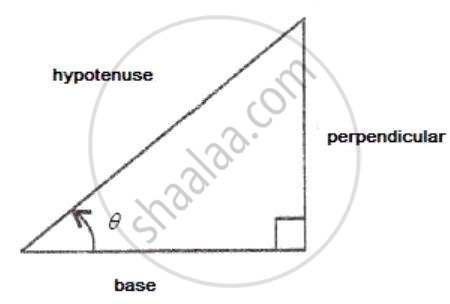
sin θ = `p/q`
i.e.`"perpendicular"/"hypotenuse" = p/h`
Therefore, if length of perpendicular = px,
Length of hypotenuse = qx
Since, hypotenuse2 = base2 + perpendicular2 ...[Using Pythagoras Theorem]
(qx)2 = base2 + (px)2
q2x2 = p2x2 + base2
q2x2 – p2x2 = base2
(q2 – p2)x2 = base2
∴ base = `sqrt(("q"^2 - "p"^"2")x^2)`
∴ base = `xsqrt("q"^2 - "p"^2) = "base"`
Now, cos θ = `"base"/"hypotenuse"`
= `(xsqrt(q^2 - p^2))/(qx)`
Therefore, cos θ + sin θ
= `(xsqrt(q^2 - p^2))/(qx) + p/q`
= `(sqrt(q^2 - p^2))/(q) + p/q`
= `(p + sqrt(q^2 - p^2))/q`
उत्तर २
Given: sin θ = `p/q`, with |p| ≤ |q| so `p/q` is a valid sine.
Step-wise calculation:
1. `sin^2θ = p^2/q^2`.
2. cos2θ = 1 – sin2θ
= `1 - p^2/q^2`
= `(q^2 - p^2)/q^2`
3. `cos θ = ± sqrt(q^2 - p^2)/|q|`. If q > 0 this is `cos θ = ± sqrt(q^2 - p^2)/q`; the sign ± is chosen according to the quadrant of θ.
4. `cos θ + sin θ = ± sqrt(q^2 - p^2)/|q| + p/q`. If q > 0 this simplifies to `(p ± sqrt(q^2 - p^2))/q`.
`cos θ + sin θ = (p ± sqrt(q^2 - p^2))/q`, with the ± matching the sign of cos θ and valid provided |p| ≤ |q|.
