Given n(𝜉) = 40, n(A') = 12, n(B) = 15 and B ⊂ A. Draw a Venn diagram to illustrate this information. Hence, find n(A − B).
Advertisements
प्रश्न
Given \[\text{n}(\xi)\] = 40, n(A') = 12, n(B) = 15 and B ⊂ A. Draw a Venn diagram to illustrate this information. Hence, find n(A − B).
आकृती
बेरीज
Advertisements
उत्तर
Given \[\text{n}(\xi)\] = 40, n(A') = 12, n(B) = 15 and B ⊂ A.
1. Number of elements in A:
n(A) = \[\text{n}(\xi)\] − n(A')
= 40 − 12
= 28
2. Number of elements only in A (since B ⊂ A, circle B lies completely inside circle A):
n(A − B) = n(A) − n(B)
= 28 − 15
= 13
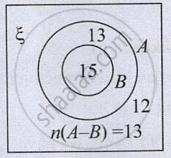
The Venn diagram above displays the number of elements in each region of sets A and B inside the universal set \[\xi\].
n(A − B) = 13
shaalaa.com
या प्रश्नात किंवा उत्तरात काही त्रुटी आहे का?
