Advertisements
Advertisements
प्रश्न
Given below are the sketches of two types of cells A and B.

(a) Which one of these is a plant cell? Give reasons in support of your answer.
(b) List the cell structures which are common to both types.
(c) Name the structures found only in plant cells and those found only in animal cells.
Advertisements
उत्तर
(a) In the above Fig. B is a plant cell. It has a cell wall and a large vacuole which pushes the nucleus towards the periphery.
(b) The cell membrane, ribosomes, nucleus, endoplasmic reticulum, lysosomes, Golgi body and mitochondria are common to both the types.
(c) Plastids and cell walls are found only in plant cells. A centrosome is found only in the animal cells.
APPEARS IN
संबंधित प्रश्न
Make sketches of animal and plant cells. State three differences between them.
State whether the following statement is true (T) or False (F):
Plant cells contain large vacuoles.
List the major differences between a plant cell and an animal cell
Fill in the blanks:
In a plant cell food is manufactured in ______.
Identify the lettered parts of the typical plant cell shown in the following figure.
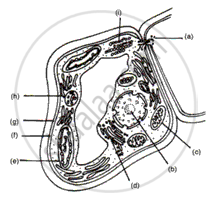
In the cell, photosynthesis is carried out with the help of ______.
The organelles of both plants and animals are made up of cells.
True or False – If false give the correct answer
Animal cells have a cell wall
Plants prepared food with the help of ______.
Give two examples of unicellular plants.
