Advertisements
Advertisements
प्रश्न
Given alongside is a partial diagrammatic representation of a certain phenomenon pertaining to the nervous system.
 |
- Name the parts numbered 1-7.
- Name the phenomenon that the diagram depicts and define it.
- Give the technical term for the point of contact between two nerve cells.
- Name the parts not shown in the diagram that should be included to complete the pathway of the phenomenon.
Advertisements
उत्तर
-
- White matter
- Spinal cord
- Dorsal root (sensory)
- Association Neuron
- Ventral root
- Gray matter
- Central Canal
- The diagram depicts spinal reflex action.
It is an automatic/quick/immediate, involuntary action in the body brought about by a stimulus. - Synapse
- Receptor, sensory neuron, motor neuron, ·spinal nerve, effector muscles
APPEARS IN
संबंधित प्रश्न
The diagram given below shows the internal structure of a spinal cord depicting a phenomena. Study the diagram and answer the questions:
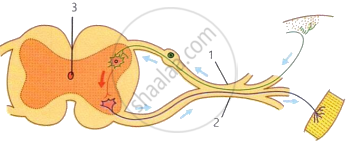
- Name the phenomenon that is depicted in the diagram. Define the phenomenon.
- Give the technical term for the point of contact between the two nerve cells.
- Name the parts numbered 1, 2 and 3.
- How does the arrangement of neurons in the spinal cord differ from that of the brain?
- Mention two ways by which the spinal cord is protected in our body.
State one function each of cerebellum and pons.
Our ______ system allows us to react to our surroundings. Information from receptors passes along ______ neurons to our brain. Our brain sends impulses along ______ neurons to our muscles.
Which of the following statements is correct about receptors?
Write down the following activities in the correct order for a simple reflex arc:
(a) impulse travels in the motor fibre
(b) impulse travels in the sensory fibre
(c) effector organ stimulated
(d) impulse crosses the synapse
State whether the following is
Cleaning
Mention, if the following statement is True or False
A reflex action is a spontaneous response to a stimulus.
Which one of the following is not a simple reflex?
If after cutting through dorsal root of a spinal nerve of a mammal, the associated receptor in skin was stimulated the animal would ______.
Which sensory organ is involved in vertigo (sensation of oneself or objects spinning around)?
