Advertisements
Advertisements
प्रश्न
Given ahead is the diagram of an experimental set up to study the process of transpiration in plants. Study the same and then answer the questions that follow:
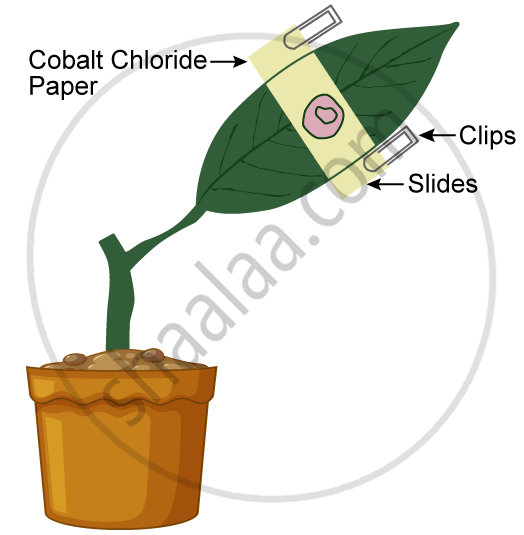
Is the experimental leaf a monocot or a dicot? Give a reason to support your answer.
Advertisements
उत्तर
The experimental leaf is a dicot leaf as it shows reticulate venation and there are more number of stomatal openings on the undersurface of a dicot leaf. Hence, transpiration is more and can be easily observed.
संबंधित प्रश्न
Name the following:
openings on the stem through which transpiration occurs.
Choose the correct answer:
Stomata open during day time because guard cells
Given ahead is a diagram of an experimental setup to study the process of transpiration in plants. Study the same and then answer the question that follows:
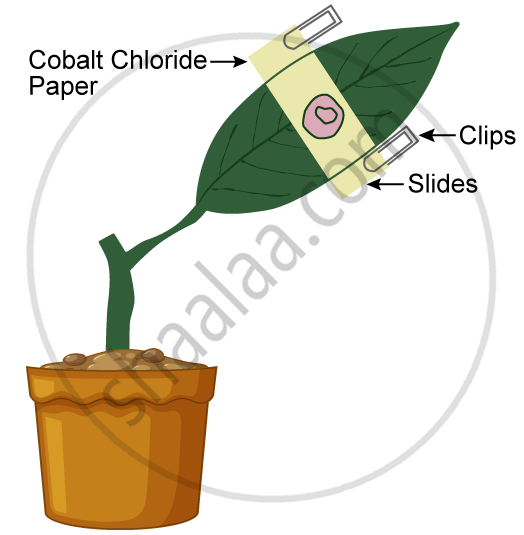
- Name the colour of dry cobalt chloride paper.
- Is the experimental leaf a monocot or a dicot? Give a reason to support your answer.
- Why are glass slides placed over the dry cobalt chloride papers?
- After about half an hour, what change, if any, would you expect to find in the cobalt chloride paper placed on the dorsal and ventral sides of the leaf? Give a reason to support your answer.
Where are stomata generally found?
State the functions of guard cells.
Explain the Term
Stomatal transpiration
The diagram below represents a structure found in a leaf.

Study the same and answer the questions that follow:
(i) Name the pis labeled A and B.
(ii) What is the biological term for the above structure?
(iii) What is the function of the part labeled A?
(iv) Mention two structural features of A, which help in the function mentioned in (iii) above.
(v) Where is this structure likely to be found in a leaf?
(vi) The above structure helps in the process of transpiration. Explain the term transpiration.
(vii) How many other cells are found surrounding this structure as seen in the diagram?
Give a reason/suitable explanation.
Leaves of some plants wilt during midday and recover in the evening.
Given below is the figure of a stoma. Study the same and answer the following questions:
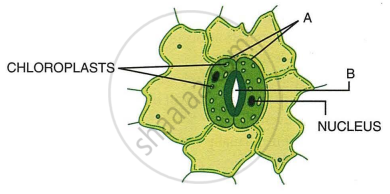
- Label the guidelines A and B.
- Write the exact location of the above-mentioned structures.
- Mention one important role of structure A.
- Write three important roles for structure B.
- Redraw the same figure when structures A are in flaccid condition. When does the flaccid condition occur?
